How to Use the Vedic Birth Chart Calculator
- Enter the birth date.
- Enter the exact birth time.
- Choose the birth city, or Other place to type coordinates.
- Pick a North Indian or South Indian chart style.
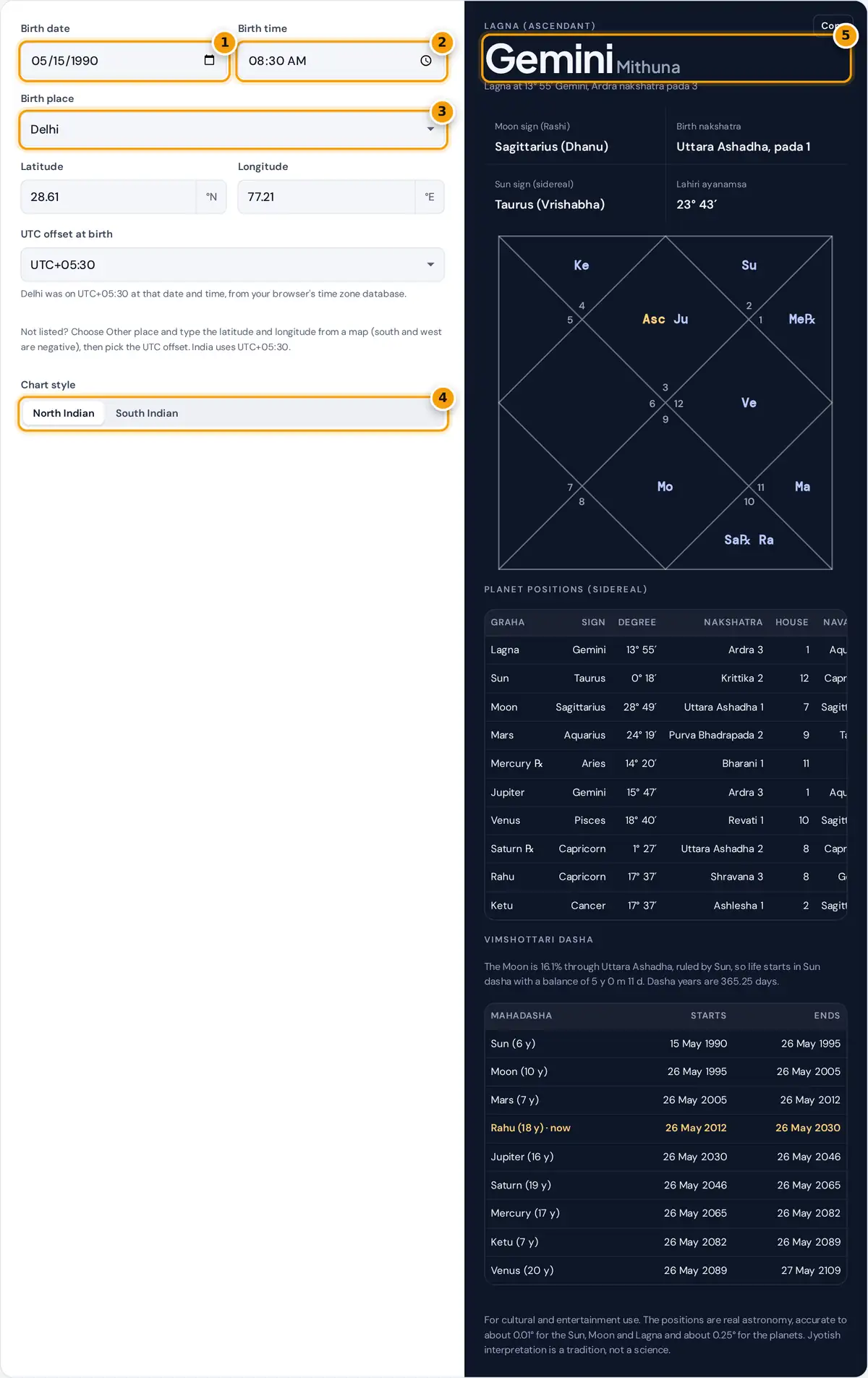
- Read the Lagna, Moon sign, nakshatra, chart, planet table and dasha.
Enter the birth date and the exact birth time from a birth certificate or hospital record. Choose the birth city from the list of about 180 cities. The latitude, longitude and UTC offset fill in automatically, including any daylight saving time in force on that date. If the city is not listed, choose Other place and type the coordinates from a map, with south latitudes and west longitudes as negative numbers, then pick the UTC offset. No location service or account is needed.
The result shows the Lagna (ascendant), the Moon sign or Rashi, the birth nakshatra and pada, the sidereal Sun sign and the ayanamsa used. Below them you get the Rasi chart in North Indian or South Indian style, a table of all nine grahas with sign, degree, nakshatra, house and navamsa sign, and the Vimshottari mahadasha periods with their dates.
How the Chart Is Calculated
The calculator first converts the local birth time to Universal Time. The Sun uses the solar theory in chapter 25 of Jean Meeus, Astronomical Algorithms, and the Moon his full lunar theory from chapter 47. Mars, Mercury, Jupiter, Venus and Saturn use the Keplerian orbital elements published by E. M. Standish of NASA’s Jet Propulsion Laboratory, solved for both the planet and the Earth and corrected for light time. Rahu is the mean lunar node and Ketu is exactly opposite.
The Lagna comes from local sidereal time: Greenwich sidereal time for the birth instant plus the birth longitude gives the right ascension of the meridian, and the ascendant is where the eastern horizon meets the ecliptic at the birth latitude. All positions are then converted from the tropical to the sidereal zodiac by subtracting the Lahiri (Chitrapaksha) ayanamsa.
sidereal longitude = tropical longitude − ayanamsa
ayanamsa (Lahiri) ≈ 23.857° + 1.39689° × T, T in centuries from 2000
nakshatra = floor(longitude ÷ 13°20′) + 1, pada = quarter of the nakshatra
Houses use the whole sign system, standard in Jyotish: the Lagna sign is the first house, the next sign the second, and so on. The Vimshottari dasha starts with the lord of the Moon’s nakshatra, and the balance at birth is the part of that nakshatra the Moon had still to cross, times the lord’s period in the 120 year cycle.
Worked Example
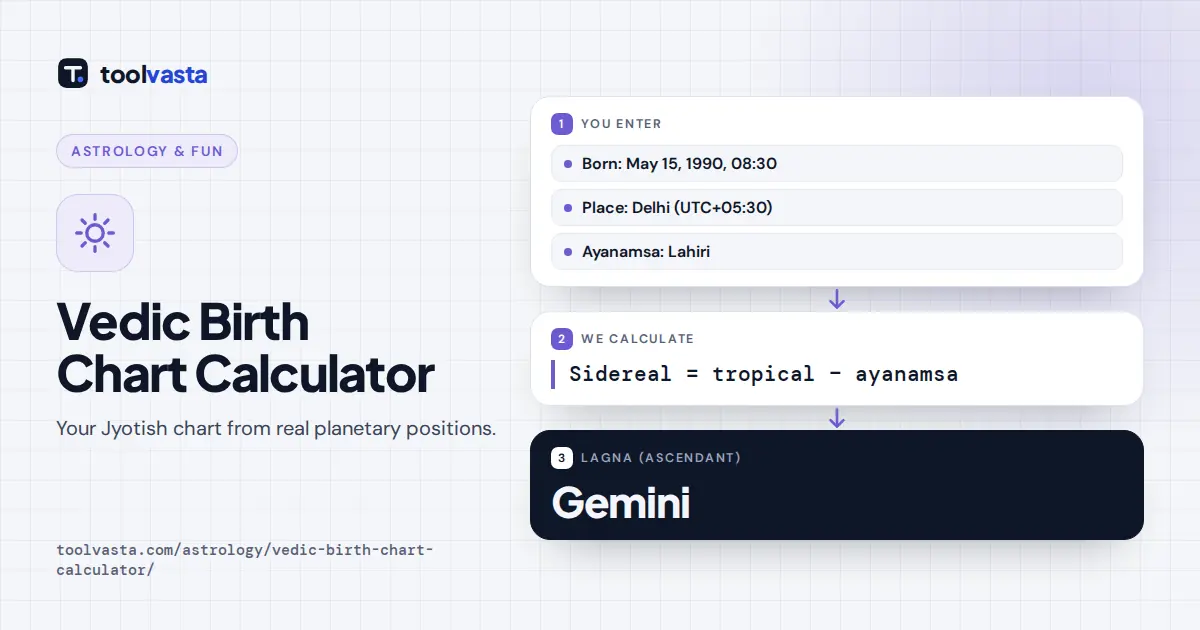
For a birth in Delhi (28.61°N, 77.21°E) on May 15, 1990 at 08:30 IST (UTC+05:30), the Lahiri ayanamsa is 23°43′. The Lagna is 13°55′ Gemini, so Gemini is the first house. The Moon is at 28°49′ Sagittarius in Uttara Ashadha nakshatra, pada 1, and the sidereal Sun has just entered Taurus at 0°18′, while a Western chart puts it at 24° Taurus. Uttara Ashadha is ruled by the Sun, and the Moon had covered 16.1% of it, so life begins in Sun dasha with a balance of 0.839 × 6 = 5.03 years, which runs until late May 1995 and is followed by ten years of Moon dasha. We checked the Sun, Moon, Lagna, Rahu and every planet against the Swiss Ephemeris in sidereal Lahiri mode. Over 300 random dates from 1800 to 2050 the Sun, Moon and Lagna agreed within 0.01° and the planets within 0.25°.
North and South Indian Chart Styles
| Style | What stays fixed | How to read it |
|---|---|---|
| North Indian | Houses | The top diamond is always the first house. Numbers show the sign in each house (1 = Aries to 12 = Pisces), and houses run counterclockwise. |
| South Indian | Signs | Pisces is top left and signs run clockwise. The Lagna sign is marked with a diagonal line and Asc. |
Both charts contain the same information. Planet abbreviations are Su (Sun), Mo (Moon), Ma (Mars), Me (Mercury), Ju (Jupiter), Ve (Venus), Sa (Saturn), Ra (Rahu) and Ke (Ketu), and ℞ marks a retrograde planet.
Accuracy and Limits
- The birth time is the biggest source of error. The Lagna moves about one degree every four minutes and the Moon about half a degree an hour.
- Time zone history comes from your browser. For births before about 1970, or in places that changed their rules, confirm the UTC offset.
- Other ayanamsas such as Raman or Krishnamurti differ from Lahiri by up to about 1.5°, which can move a planet near a sign edge.
- Rahu and Ketu are mean nodes. Some software uses the true node, which can differ by up to about 1.5°.
- Divisional charts other than the navamsa sign, yogas and antardashas are not included.
Frequently asked questions
What is a Vedic birth chart?
It is a map of the sky at your birth in the sidereal zodiac, used in Jyotish, the Indian astrological tradition. It shows the Lagna, the Moon sign and nakshatra, and the sign and house of each of the nine grahas.
What is the difference between Vedic and Western birth charts?
Vedic astrology measures positions against the fixed stars using an ayanamsa, while Western astrology uses the tropical zodiac tied to the equinoxes. Today the difference is about 24 degrees, so many placements move back one sign.
Which ayanamsa does this kundli use?
It uses the Lahiri, or Chitrapaksha, ayanamsa, the standard adopted by the Government of India's Calendar Reform Committee and the default in most Indian astrology software.
How do I find my nakshatra?
Your birth nakshatra is the one the Moon occupied at birth. The calculator divides the Moon's sidereal longitude by 13 degrees 20 minutes to find which of the 27 nakshatras it is in and which of its four padas.
How is the Vimshottari dasha calculated?
The first dasha belongs to the lord of your birth nakshatra. Its remaining length depends on how far the Moon still had to travel through that nakshatra, and the other dashas follow in a fixed order totalling 120 years.
Do I need an exact birth time for a kundli?
Yes, for the Lagna, houses and dasha balance. The Lagna changes sign roughly every two hours, and a few minutes can move a planet to another house. The planets' signs need only the date.