How to use the tarot card generator
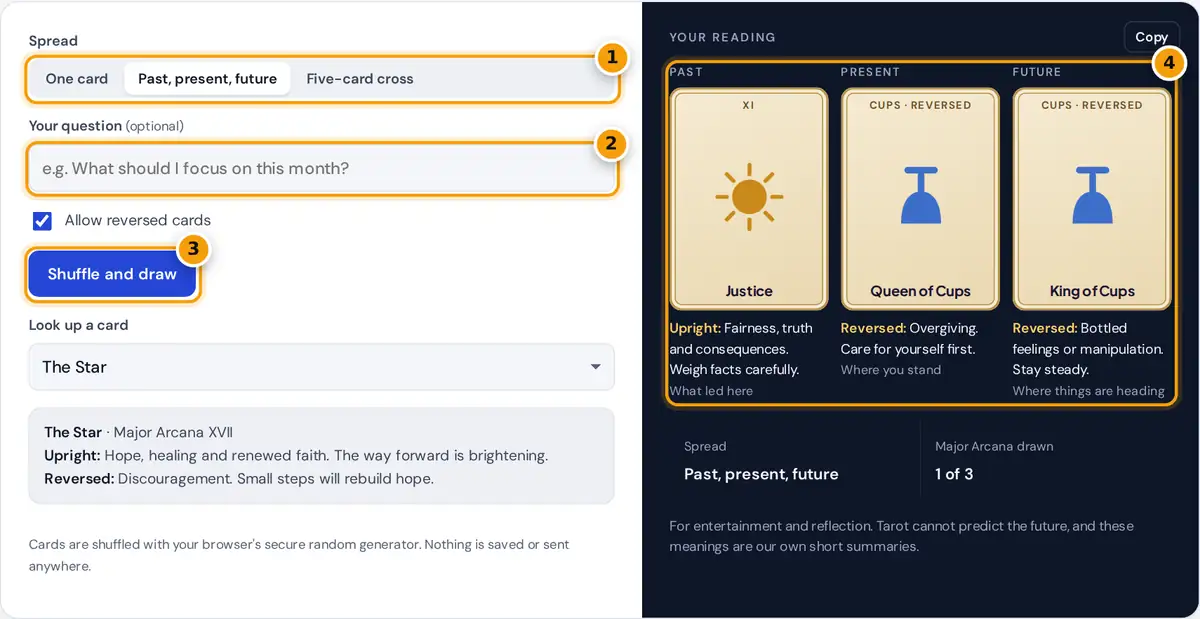
- Choose a spread: one card, past, present, future, or a five-card cross.
- Type your question if you want one, and choose whether to allow reversed cards.
- Press Shuffle and draw to deal your cards.
- Read each card and its upright or reversed meaning in its position.
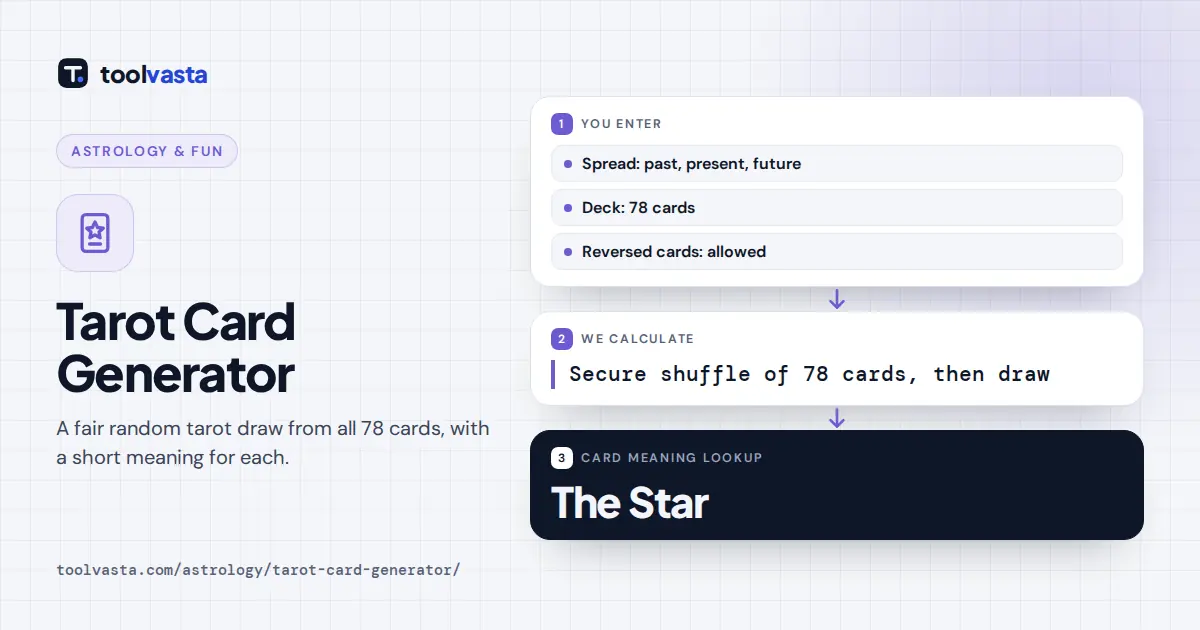
Choose a spread, type a question if you like, and press Shuffle and draw. The deck is shuffled fresh for every reading, so each card in all 78 has the same chance to appear, and no card can appear twice in one spread. Untick Allow reversed cards if you prefer to read every card upright. The copy button saves your reading as plain text so you can keep a journal of pulls.
Tarot spreads explained
- One card: a quick daily pull or a simple prompt for a single question. Some people use it as a yes or no reading, treating upright as yes and reversed as not yet.
- Past, present, future: the classic three-card spread. The first card shows what led to the situation, the second where you stand now, the third where things are heading if nothing changes.
- Five-card cross: the present situation in the center, the challenge, the past, the near future and a card of advice.
The 78-card deck
This generator follows the structure of the Rider-Waite deck first published in 1909, the most widely used tarot layout today. Card images are not shown; each card is drawn as a simple symbol so the page stays fast.
| Part | Cards | Traditional theme |
|---|---|---|
| Major Arcana | 22 cards, The Fool (0) to The World (XXI) | Big life lessons and turning points |
| Wands | 14 cards | Energy, ambition and creativity |
| Cups | 14 cards | Feelings and relationships |
| Swords | 14 cards | Thoughts, words and conflict |
| Pentacles | 14 cards | Money, work and the physical world |
Each suit runs from Ace to Ten, followed by four court cards: Page, Knight, Queen and King. The card meanings on this page are short summaries we wrote ourselves, based on the common themes of each card. Readers interpret cards in many different ways, so treat them as prompts for your own thinking.
How the cards are shuffled
The generator uses the Fisher-Yates shuffle with your browser’s cryptographic random number source, the same method used in our random number generator. Every one of the 78! possible orders is equally likely. When reversals are on, each card has an independent 50% chance of landing upside down.
chance of a specific card in a one-card pull = 1 ÷ 78 ≈ 1.28%
chance of at least one Major Arcana card in three = 1 − (56 × 55 × 54) ÷ (78 × 77 × 76) ≈ 63.6%
Tips for a reflective reading
- Ask open questions such as “What should I keep in mind about…” rather than questions with a fixed answer.
- Read the cards together. A run of Cups points to feelings, while several Major Arcana cards suggest a bigger theme.
- Notice your first reaction to a card. Tarot works best as a mirror for your own thoughts.
Entertainment only
Tarot is a tradition of storytelling and reflection. It cannot predict events, and a random draw has no knowledge of your situation. Please do not use it in place of advice from a doctor, lawyer, financial adviser or counselor.
Frequently asked questions
Is this tarot card generator really random?
Yes. It shuffles all 78 cards with the Fisher-Yates method and your browser's secure random source, so every card is equally likely and no card repeats within a spread.
How many cards are in a tarot deck?
78: 22 Major Arcana cards and 56 Minor Arcana cards in four suits of 14 (Wands, Cups, Swords and Pentacles).
What does a reversed tarot card mean?
A reversed card usually points to the card's energy being blocked, delayed or turned inward. You can switch reversals off if you prefer upright readings.
What is a three-card tarot spread?
The most popular quick spread: the first card is the past, the second the present and the third the likely future.
Can tarot predict the future?
No. Tarot is for entertainment and reflection. The cards can prompt new ways of looking at a question, but they cannot foresee events.