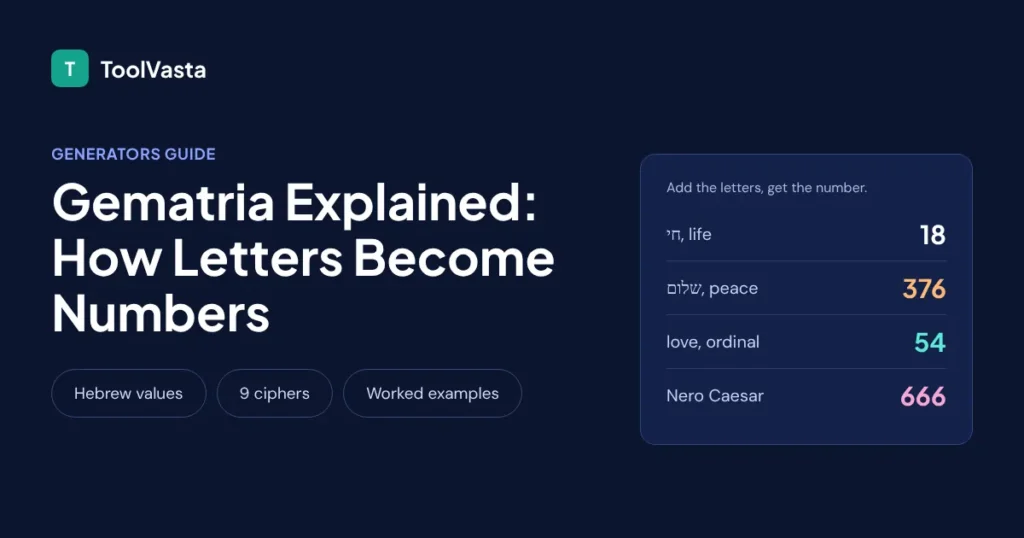
Gematria is the old practice of reading a word as a number. Each letter of the alphabet is given a value, the values are added together, and the total becomes the word's number. If you want to try it as you read, the gematria calculator shows the value of any Hebrew or English word in nine ciphers at once, with the letter-by-letter sum underneath.
This guide explains where gematria comes from, how the standard Hebrew values work, how the main ciphers differ, and how to read a result without reading too much into it. The examples use real words and real arithmetic, so you can check every total yourself.
Where Does Gematria Come From?
Gematria comes from a simple fact: for most of history, Hebrew had no separate digits. Before Arabic numerals spread, Hebrew writers used the 22 letters of the alphabet as numbers, just as Romans used I, V and X. Because the same symbols served as letters and numerals, every written word already had a numerical total hiding inside it.
Greek worked the same way. Its version of the practice is called isopsephy, and one of the best known examples is a graffito from Pompeii that reads "I love her whose number is 545". The writer hid the woman's name in a sum that only someone who knew it could check. According to the Encyclopaedia Britannica's overview of gematria, the word itself probably comes from the Greek geometria, and the technique became a recognised method of interpretation in rabbinic literature and later in Kabbalah.
Letter numerals are still in everyday use in Hebrew today. Dates on the Jewish calendar, chapter and verse numbers in printed Bibles, and the numbered pages of the Talmud are all written with letters.
How Are Hebrew Letters Turned into Numbers?
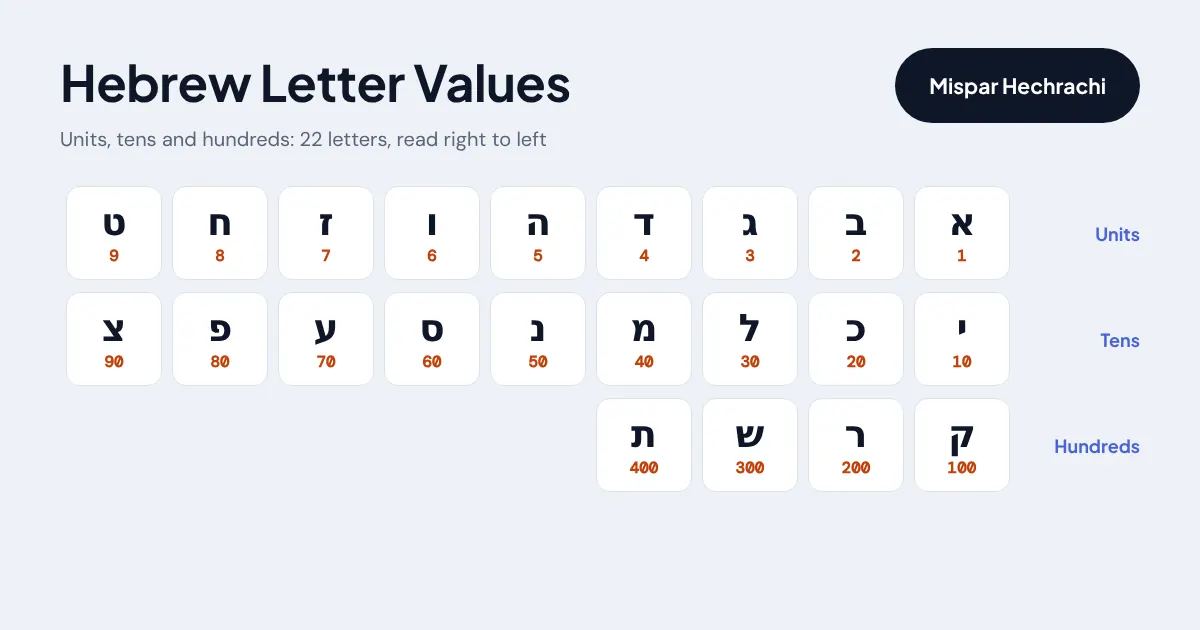
Hebrew letters are turned into numbers in three rows of nine: the first nine letters are the units 1 to 9, the next nine are the tens 10 to 90, and the last four are the hundreds 100 to 400. This system is called Mispar Hechrachi, the standard or absolute value.
| Group | Letters (right to left) | Values |
|---|---|---|
| Units | א ב ג ד ה ו ז ח ט | 1, 2, 3, 4, 5, 6, 7, 8, 9 |
| Tens | י כ ל מ נ ס ע פ צ | 10, 20, 30, 40, 50, 60, 70, 80, 90 |
| Hundreds | ק ר ש ת | 100, 200, 300, 400 |
| Final forms | ך ם ן ף ץ | Same as regular form (500 to 900 in Mispar Gadol) |
To find a word's value, add the value of each letter. There is no rule about order or position in the standard method, so the same letters in a different order give the same total.
Three worked examples
- חי (chai, "life"): chet 8 + yod 10 = 18. This is why gifts and donations in Jewish tradition are often given in multiples of 18.
- אמת (emet, "truth"): aleph 1 + mem 40 + tav 400 = 441.
- שלום (shalom, "peace"): shin 300 + lamed 30 + vav 6 + final mem 40 = 376.
Numbers above 400 are written by combining letters. The Hebrew year 5787, which began in September 2026, is written תשפ״ז: tav 400 + shin 300 + pe 80 + zayin 7 = 787, with the thousands understood. The two short marks before the last letter (gershayim) tell the reader that the letters are a number, not a word.
One tradition shows how seriously the letters are taken. The numbers 15 and 16 would naturally be written יה and יו, but both spell forms of the divine name, so they are written טו (9 + 6) and טז (9 + 7) instead. Hebrew text often arrives with vowel points under the letters; those dots and dashes are separate characters in the Unicode Hebrew block and carry no value, so a calculator should strip them before adding.
What Are the Main Ciphers?
The main gematria ciphers are different tables of letter values applied with the same "add them up" rule. Four are traditional Hebrew methods and the rest are modern English systems.
Hebrew methods
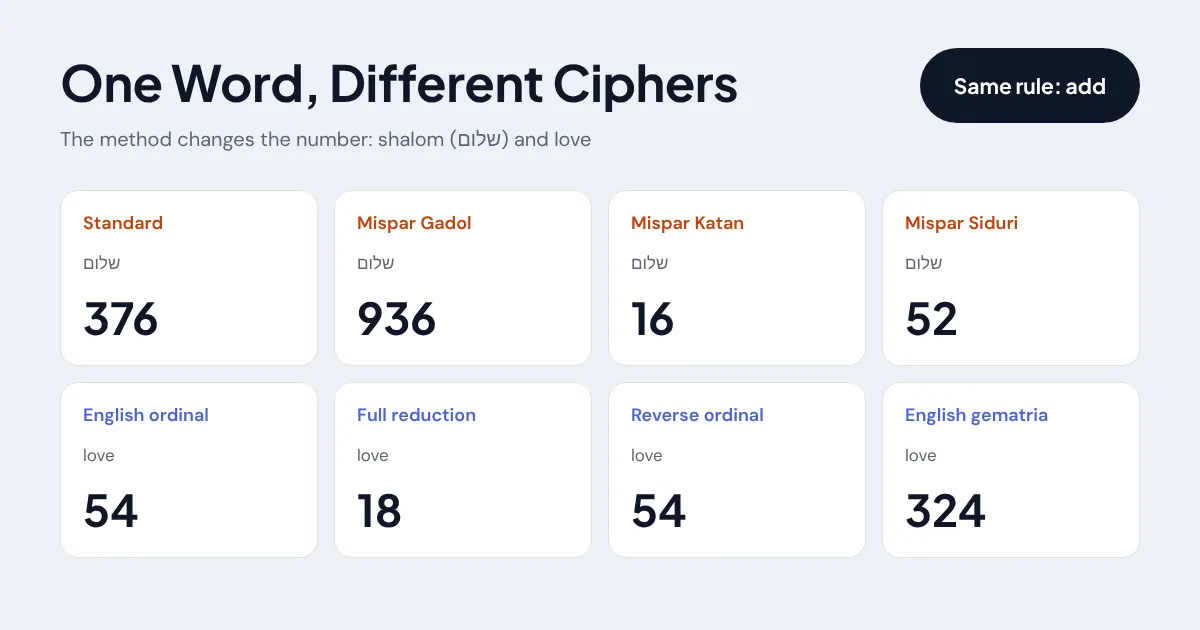
- Mispar Hechrachi (standard): the values above, with final letters counted like regular ones.
- Mispar Gadol (large): the same, except the five final forms count 500, 600, 700, 800 and 900. שלום ends in a final mem, so its Gadol value is 300 + 30 + 6 + 600 = 936.
- Mispar Katan (small): zeros are dropped, so every letter becomes 1 to 9. Shin 300 becomes 3 and lamed 30 becomes 3, giving שלום a value of 3 + 3 + 6 + 4 = 16.
- Mispar Siduri (ordinal): each letter's position in the alphabet, 1 to 22. Tav is 22 rather than 400.
English methods
English ciphers apply the idea to the Latin alphabet. They are 20th and 21st century inventions with no roots in Jewish tradition, which matters if you see them quoted as ancient. The common ones are English ordinal (A = 1 to Z = 26), full reduction (A to I = 1 to 9, then the cycle repeats), reverse ordinal (A = 26 to Z = 1) and a version usually called English gematria, where each ordinal value is multiplied by 6.
Take the word "gematria" itself. In English ordinal it is G 7 + E 5 + M 13 + A 1 + T 20 + R 18 + I 9 + A 1 = 74. Multiply by 6 and the English gematria value is 444. Full reduction gives 38, and reverse ordinal gives 142.
Which Famous Numbers Come Up Most Often?
The most famous gematria examples come from scripture and its commentators, where an equal total is treated as a hint that two ideas are linked.
- Abraham's 318 men. Genesis 14:14 says Abraham took 318 trained men to battle. The Talmud notes that the name of his servant Eliezer, אליעזר, is 1 + 30 + 10 + 70 + 7 + 200 = 318, and reads the verse as saying that Eliezer alone was worth an army.
- The number of the beast. Revelation 13:18 gives 666. Many scholars read it as "Nero Caesar" spelled in Hebrew letters, נרון קסר: 50 + 200 + 6 + 50 + 100 + 60 + 200 = 666. Some early manuscripts read 616, which matches the spelling without the final nun.
- Wine and secrets. יין (wine) and סוד (secret) both total 70, the basis of the saying "when wine goes in, a secret comes out".
In each case the number does not prove anything on its own. It points a reader towards a connection that the surrounding text already suggests.
Is It Random, or Can You Trust the Results?
Gematria is not random at all: the same word in the same cipher always gives the same number. That makes it the opposite of a coin flip, where each toss is independent and unpredictable. What gematria cannot do is tell you whether a match means something.
The reason is simple arithmetic. Most short words total somewhere between 10 and 1,500, while Hebrew and English each have tens of thousands of words. Many unrelated words must share a total, just as several people in a large class share a birthday. If you search through enough names, phrases and ciphers, you will always find a striking match. Choosing which ciphers to check after you have seen the results is the same mistake as flipping a coin until it lands heads five times and calling the coin lucky.
A fair way to test a claim is to fix the rules first: pick one cipher, pick the words, then calculate. You can even pick test words at random with the random name picker, paste a list of names, draw a few, and see how often a "meaningful" total turns up by chance. Usually it turns up quite often.
How Can You Work Out a Word's Value Yourself?
You can calculate gematria by hand in a minute with the table above, or let a tool do the adding. To work it out on paper:
- Write the word in Hebrew letters (or English letters for an English cipher) and remove any vowel points.
- Look up the value of each letter in your chosen cipher.
- Add the values together to get the total.
- If you want a single digit, add the digits of the total until one remains: 376 becomes 3 + 7 + 6 = 16, then 1 + 6 = 7.
For long phrases, typing them into the gematria calculator saves time and avoids slips with final letters. It accepts pasted Hebrew with vowel points, includes an on-screen Hebrew keyboard, and shows the standard, Gadol, Katan and ordinal values alongside the English ciphers, so you can see at a glance how much the answer depends on the method.
Treat the numbers as a way into the text, the way traditional commentators did. A total of 18 explains a custom, and 318 opens a conversation about a verse. A number alone, found after trying a dozen ciphers, explains much less.
Frequently asked questions
What does gematria mean?
Gematria is the practice of assigning a number to each letter of an alphabet and adding them to find the numerical value of a word or phrase. It is best known from Hebrew, where letters also served as numerals.
Is gematria part of Judaism?
Gematria appears in rabbinic literature and Kabbalah as one of many methods of interpretation. It is used to support or illustrate a reading, not as a source of law on its own.
What is the gematria of 18?
18 is the value of חי (chai), meaning "life": chet 8 + yod 10. It is why gifts in Jewish tradition are often given in multiples of 18.
Does English gematria work the same way?
It uses the same adding method with values for the Latin alphabet, such as A = 1 to Z = 26. English ciphers are modern inventions, so they have no traditional authority.
Why do different calculators give different answers?
They usually use different ciphers or treat final Hebrew letters differently. Check which cipher a result uses before comparing it with another source.