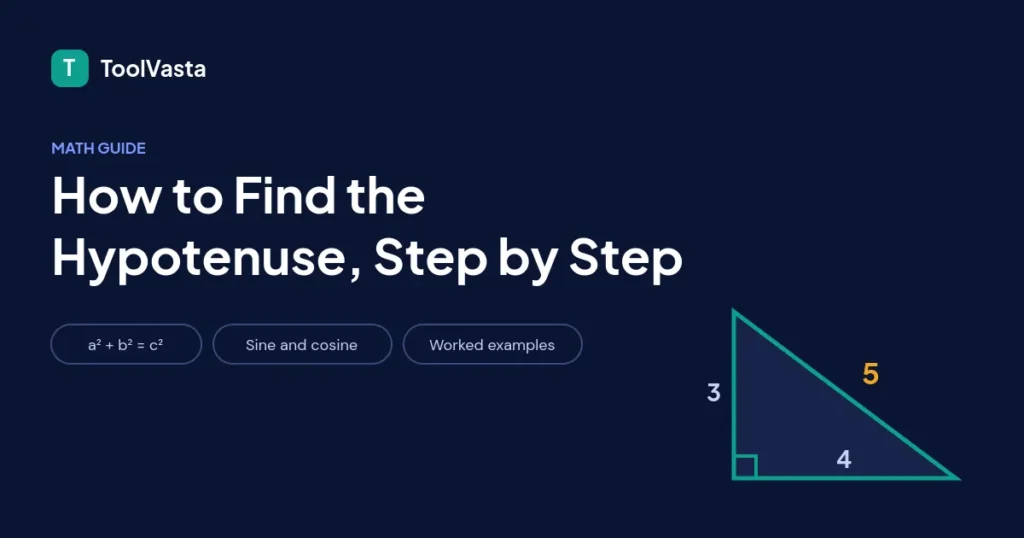
To find the hypotenuse of a right triangle, square the two legs, add them, and take the square root: c = √(a² + b²). Legs of 3 and 4 give √25 = 5. That one line solves most textbook questions, and the hypotenuse calculator does it instantly, but real problems often hand you an angle, an area or a messy decimal instead of two neat legs. This guide walks through every common case step by step, shows the mistakes that cost marks, and explains how to round and check your answer.
What Is the Hypotenuse?
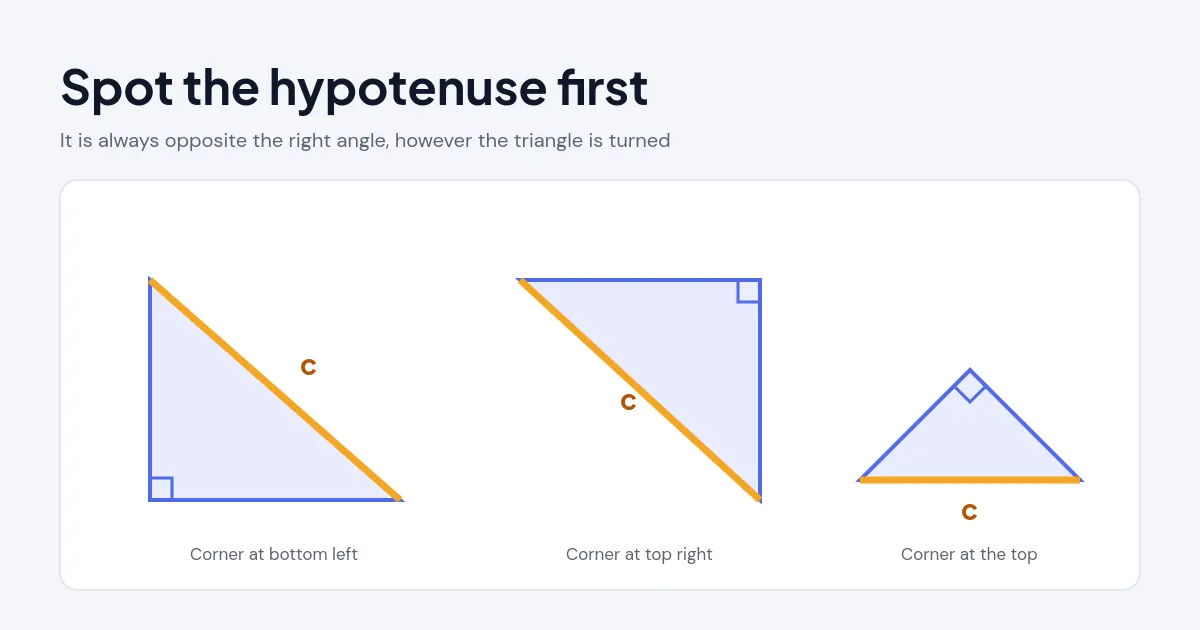
The hypotenuse is the side of a right triangle that sits opposite the 90° angle. The other two sides, the ones that meet to form the square corner, are called legs. Because the right angle is the largest angle in the triangle, the side facing it is always the longest side.
That gives you a quick way to label any diagram, even one that is rotated or flipped. Find the small square that marks the right angle, then look straight across the triangle. Whatever side you hit is c. Labeling first matters because every formula below assumes you know which side is the hypotenuse and which sides are legs.
How Do You Find the Hypotenuse from Two Legs?
When you know both legs, use the Pythagorean theorem, a² + b² = c². It is one of the oldest results in mathematics: Euclid proved it as Proposition 47 in Book I of the Elements, and Clark University's online edition of Euclid shows the original proof with its famous diagram of squares on each side.
Step by step
- Write down the two legs, for example a = 6 and b = 8.
- Square each leg: 6 squared is 36 and 8 squared is 64.
- Add the squares: 36 + 64 = 100.
- Take the square root of the total: the square root of 100 is 10.
- Check the answer is longer than each leg and shorter than their sum.
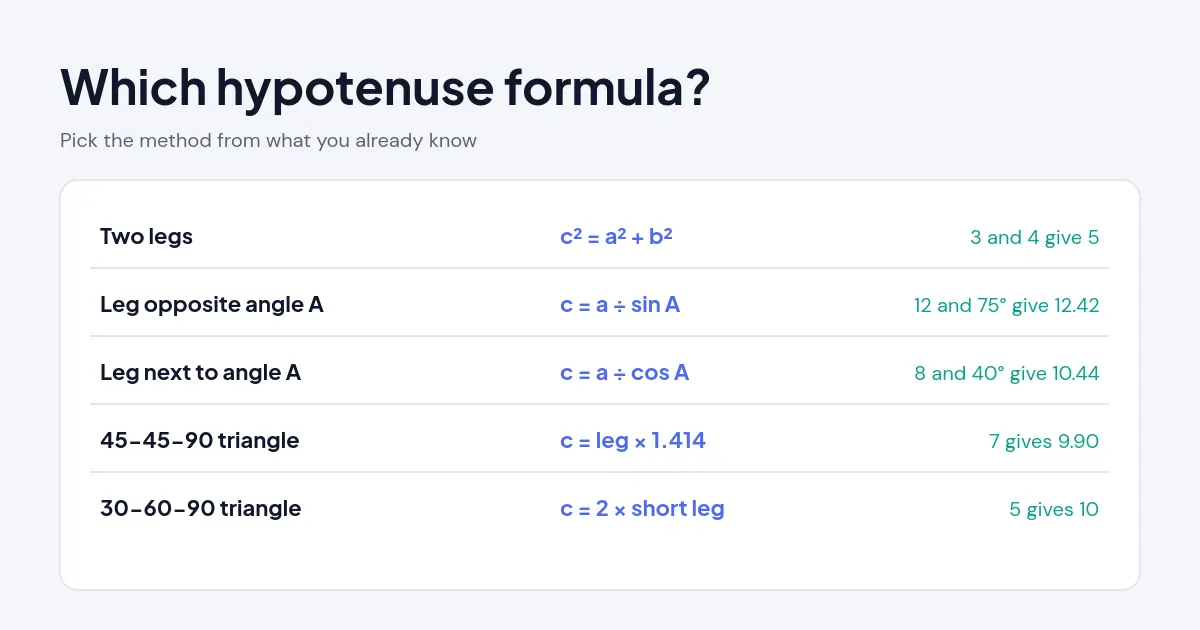
So the hypotenuse is 10. The same method works with decimals. A laptop screen that is 11.3 inches wide and 7.1 inches tall has a diagonal of √(11.3² + 7.1²) = √(127.69 + 50.41) = √178.1 = 13.35 inches, which is why it is sold as a 13.3 inch model.
Shortcuts worth memorizing
Some leg pairs give whole number answers. These are Pythagorean triples: 3, 4, 5; 5, 12, 13; 8, 15, 17; and 7, 24, 25. Any multiple of a triple is also a triple, so 6, 8, 10 and 30, 40, 50 work too. If a test question gives legs of 9 and 12, you can spot that they are 3 × (3, 4) and answer 15 without a calculator.
Students in the United States meet this skill in eighth grade. The Common Core geometry standard 8.G.B.7 asks them to apply the theorem to find unknown sides in real-world problems in two and three dimensions, so expect word problems about ladders, ramps, screens and room diagonals.
How Do You Find the Hypotenuse with One Side and an Angle?
When you know one leg and one of the acute angles, use sine or cosine. The rule to remember is SOH CAH: sine is opposite over hypotenuse, cosine is adjacent over hypotenuse. Rearranged for the hypotenuse, those become simple divisions.
Angle opposite the known leg
If the angle faces the side you know, divide that side by the sine of the angle: c = a ÷ sin A. A ladder that must reach 12 feet up a wall at 75° to the ground needs c = 12 ÷ sin 75° = 12 ÷ 0.9659 = 12.42 feet.
Angle next to the known leg
If the angle touches the side you know, divide by the cosine instead: c = a ÷ cos A. A ramp that covers 8 feet of ground at 40° has a sloped surface of 8 ÷ cos 40° = 8 ÷ 0.7660 = 10.44 feet. Set your calculator to degrees before you start; in radian mode cos 40 gives a very different number and a wrong answer.
Special triangles
Two triangles come up so often that their ratios are worth knowing. In a 45-45-90 triangle the legs are equal and the hypotenuse is the leg times √2, about 1.414, so a leg of 7 gives 9.90. In a 30-60-90 triangle the hypotenuse is exactly twice the shortest leg, so a short leg of 5 gives 10. For any other combination of sides and angles, the right triangle calculator solves the whole shape from two values.
Can You Find the Hypotenuse from the Area or Perimeter?
Yes, as long as you also know one leg. Puzzle questions and some exams like these because they test whether you understand the relationships rather than one memorized formula.
From one leg and the area
The area of a right triangle is half the product of the legs, so the missing leg is b = 2 × area ÷ a. With a = 9 and an area of 54, b = 108 ÷ 9 = 12, and c = √(81 + 144) = √225 = 15.
From one leg and the perimeter
Subtract the known leg from the perimeter to get s, the other leg plus the hypotenuse. Then c = (s + a² ÷ s) ÷ 2. With a = 5 and a perimeter of 30, s = 25, so c = (25 + 1) ÷ 2 = 13, and the triangle is the 5, 12, 13 triple. The calculator has a mode for each of these, so you can check your algebra in seconds.
How Should You Round the Hypotenuse?
Most hypotenuse answers are irrational numbers that never end, so rounding is part of the job. Keep every digit on your calculator until the final step, then round once. Rounding the squares or the sum along the way can shift the last digit of the answer.
Follow the precision the question asks for, usually one or two decimal places, or the nearest tenth of an inch for measurements. The rounding calculator handles any place value and shows the deciding digit, which helps when a teacher wants the working. If you are giving the answer in exact form instead, simplify the square root: √50 becomes 5√2, and the radical calculator does that step.
| Legs | Exact hypotenuse | Nearest tenth | Nearest hundredth |
|---|---|---|---|
| 1 and 1 | √2 | 1.4 | 1.41 |
| 2 and 3 | √13 | 3.6 | 3.61 |
| 5 and 5 | 5√2 | 7.1 | 7.07 |
| 4 and 7 | √65 | 8.1 | 8.06 |
How Do You Check Hypotenuse Measurements in the Real World?
Builders use the hypotenuse to check that corners are square. Measure 3 feet along one wall and 4 feet along the other; if the diagonal between the marks is exactly 5 feet, the corner is 90°. For a larger frame, measure both diagonals of the rectangle: they should match, and each should equal √(width² + length²).
When you measure many identical pieces, such as the diagonal braces in a run of shelving units, individual readings will vary a little. Converting each reading to a standard score with the z score calculator flags any brace that is unusually far from the average, which often points to a cutting error. If you are planning a quality check rather than measuring everything, the sample size calculator tells you how many pieces to measure to estimate the average within a chosen margin.
Which Mistakes Should You Avoid?
- Adding the legs before squaring. (3 + 4)² is 49, not 25.
- Forgetting the final square root and reporting c² instead of c.
- Using the formula on a triangle without a right angle. For those, use the law of cosines.
- Mixing up opposite and adjacent, which swaps sine and cosine.
- Leaving the calculator in radian mode when the angle is in degrees.
- Mixing units, such as one leg in feet and the other in inches. Convert first.
A two-second sense check catches most of these: the hypotenuse must be longer than each leg but shorter than the two legs added together. If it is not, go back to the inputs. For the reverse problem, finding a missing leg from the hypotenuse, use a = √(c² − b²) or the Pythagorean theorem calculator.
Frequently asked questions
What is the formula for the hypotenuse?
c = √(a² + b²), where a and b are the legs. With an angle, use c = a ÷ sin A when the angle is opposite the known side, or c = a ÷ cos A when it is next to it.
Is the hypotenuse always the longest side?
Yes. It faces the right angle, the largest angle in the triangle, so it is always longer than either leg.
How do you find the hypotenuse without a calculator?
Look for a Pythagorean triple such as 3, 4, 5 or 5, 12, 13, or a multiple of one. Otherwise square, add and estimate the square root between the nearest perfect squares.
Can you find the hypotenuse with only one side?
Not on its own. You need a second piece of information: another side, an acute angle, the area or the perimeter.
Does every triangle have a hypotenuse?
No. Only right triangles have one. Other triangles simply have a longest side.