Quick answer: eGFR and creatinine clearance both estimate how well your kidneys filter blood, using the creatinine level from a blood test. An eGFR of 90 or more is normal, 60 to 89 is mildly reduced, and below 60 for at least 3 months means chronic kidney disease. Creatinine clearance gives a similar figure in mL/min and is mainly used to set drug doses.
Kidney results arrive as a list of abbreviations and numbers, and two of them cause most of the questions: eGFR and creatinine clearance. Both are calculated from the same blood test, both are given in millilitres per minute, and yet they rarely match. This guide explains what each number measures, where the cut-off points sit, and why a single low result is often less worrying than it looks. You can check your own figures with the eGFR calculator and the creatinine clearance calculator as you read.
What Is Creatinine and Why Is It Measured?
Creatinine is a waste product released as your muscles use energy. Your body makes it at a fairly steady rate, the kidneys filter it out of the blood, and it leaves in your urine. When the kidneys filter less, creatinine builds up, so a higher blood creatinine usually means lower kidney function.
The catch is that creatinine also depends on how much muscle you have. A muscular young man can have a creatinine of 110 µmol/L with perfectly healthy kidneys, while a small, frail woman of 85 can have a “normal” 70 µmol/L and quite reduced kidney function. That is why laboratories do not simply report creatinine on its own. They feed it into an equation that also uses your age and sex, which gives the estimated glomerular filtration rate.
In the UK, creatinine is reported in micromoles per litre (µmol/L). In the US it is reported in milligrams per decilitre (mg/dL). To convert, divide µmol/L by 88.4, so 88 µmol/L is about 1.0 mg/dL.
What Does Your eGFR Number Mean?
Your eGFR is an estimate of how many millilitres of blood your kidneys filter each minute, scaled to an average adult body surface area of 1.73 m². In England and Wales it is calculated with the CKD-EPI 2009 creatinine equation, without the ethnicity adjustment that was removed in 2021, as set out in NICE guideline NG203. Many US laboratories now use the newer 2021 version, which tends to give a slightly higher figure.
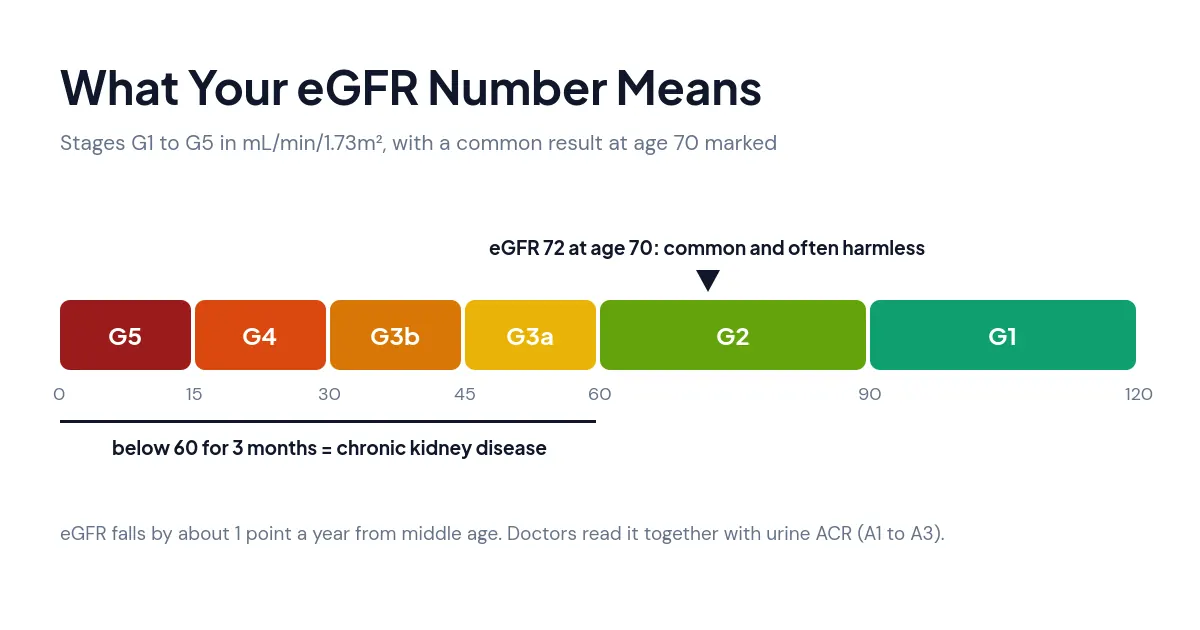
Doctors sort the result into six stages:
| Stage | eGFR | What it usually means |
|---|---|---|
| G1 | 90 or more | Normal filtering. Only counts as kidney disease if there is another sign, such as protein in the urine |
| G2 | 60 to 89 | Slightly reduced. Very common with age and often harmless on its own |
| G3a | 45 to 59 | Mild to moderate reduction. Chronic kidney disease if it lasts 3 months or more |
| G3b | 30 to 44 | Moderate to severe reduction. Regular monitoring and a review of medicines |
| G4 | 15 to 29 | Severe reduction. Usually managed with a kidney specialist |
| G5 | Below 15 | Kidney failure. Dialysis or a transplant may be discussed |
Two points help when reading the table. First, many UK laboratories report any value above 90 as “>90”, because the equation is less precise at the top and the meaning is the same. Second, eGFR falls naturally by roughly one point a year from middle age. A 75-year-old with a stable eGFR of 65 and no protein in the urine is usually not considered to have kidney disease at all.
Why Does Urine ACR Matter as Much as eGFR?
The urine albumin to creatinine ratio (ACR) shows how much protein is leaking from the kidneys into the urine, and it is the second half of the picture. Healthy kidneys keep albumin in the blood. Damaged filters let it through, sometimes years before eGFR starts to fall.
ACR is grouped into three categories: A1 is below 3 mg/mmol, A2 is 3 to 30 mg/mmol and A3 is above 30 mg/mmol. Your risk of kidney disease getting worse, and of heart disease, depends on both numbers together. Someone in stage G3a with an ACR of A1 is at moderate risk. The same eGFR with an ACR of A3 is very high risk and normally leads to a referral. The UK Kidney Association staging guide sets out the full grid, and the eGFR calculator on ToolVasta shows your combined category if you enter both results.
What Is Creatinine Clearance and How Is It Different?
Creatinine clearance is another estimate of kidney filtering, calculated with the Cockcroft-Gault formula from 1976. It uses your age, sex, weight and creatinine:
Women: multiply by 0.85
Unlike eGFR, the answer is not scaled to body size, so weight changes it directly. That is exactly why pharmacists still use it. Most drug dosing tables were built from Cockcroft-Gault studies, so antibiotics, blood thinners such as apixaban or rivaroxaban, and some diabetes medicines are adjusted using creatinine clearance rather than eGFR.
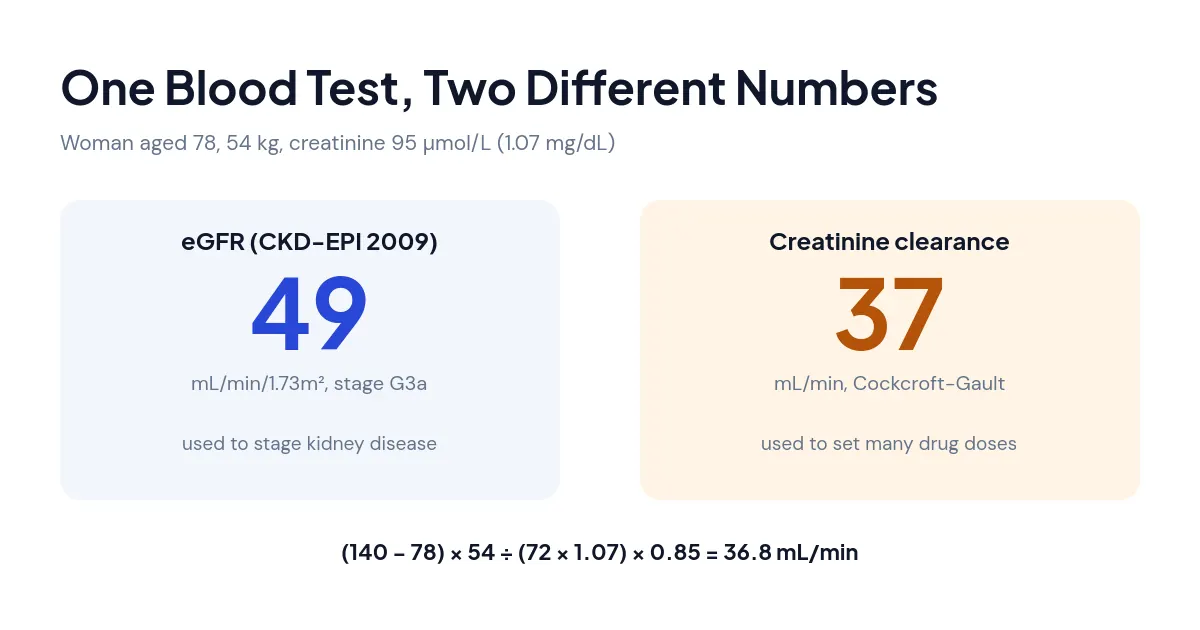
The two numbers can be far apart, especially in older and lighter people. Take a woman aged 78 who weighs 54 kg, with a creatinine of 95 µmol/L (1.07 mg/dL). Her eGFR from CKD-EPI 2009 is about 49, stage G3a. Her creatinine clearance is (140 − 78) × 54 ÷ (72 × 1.07) × 0.85, which is about 37 mL/min. For a drug with a cut-off at 50, the choice of number decides the dose. This is one reason your pharmacist may ask for your weight when checking a prescription.
Weight also matters at the other end. In someone with obesity, using actual body weight overstates creatinine clearance, so pharmacists often switch to ideal or adjusted body weight. The creatinine clearance calculator shows all three side by side.
What Can Make Your Results Look Worse Than They Are?
Several everyday things can raise creatinine for a day or two, which pushes eGFR down without any lasting kidney problem:
- Dehydration. A hot day, a stomach bug or not drinking much can raise creatinine noticeably.
- A large meat meal. Cooked meat contains creatine, which turns into creatinine. NICE advises avoiding meat in the 12 hours before the test.
- Hard exercise. A long run or heavy gym session the day before can lift the result.
- Creatine supplements. These raise creatinine directly, so tell your GP if you take them.
- Some medicines. Trimethoprim, for example, reduces how much creatinine the kidneys secrete, raising the blood level without harming the kidneys.
Muscle mass works in both directions. Bodybuilders often get falsely low eGFR results, while amputees, people with low muscle mass and those who eat little meat may get falsely reassuring ones. When there is doubt, doctors can request a cystatin C test, which is much less affected by muscle.
What Should You Do After an Abnormal Result?
A single eGFR below 60 is a reason to repeat the test, not a diagnosis. Chronic kidney disease is only diagnosed when the eGFR stays below 60, or the ACR stays raised, for at least 3 months. Your GP will usually repeat the blood test within 2 weeks if the result has dropped suddenly, then again after 3 months.
The most useful thing you can do between tests is look after the factors that drive kidney damage. High blood pressure is the biggest. NICE recommends a target below 140/90 in clinic for most people with CKD, and lower when the ACR is 70 mg/mmol or more, so averaging your home readings with the blood pressure calculator gives your GP a clearer picture than one surgery reading. Good diabetes control, not smoking, staying active and keeping a healthy weight all help. If you need to convert your height for a weight or BMI calculation, the height calculator handles centimetres and feet and inches.
Seek urgent advice if a low result comes with very little urine, swollen legs, breathlessness or confusion, because these can be signs of acute kidney injury rather than slow, long-term change.
Frequently asked questions
Is eGFR the same as creatinine clearance?
No. Both estimate kidney filtering from blood creatinine, but eGFR uses the CKD-EPI equation and is scaled to 1.73 m², while creatinine clearance uses the Cockcroft-Gault formula with your body weight. eGFR is used to stage kidney disease and creatinine clearance is mainly used for drug doses.
What eGFR is worrying?
An eGFR that stays below 60 for 3 months, falls by 25% or more and moves to a lower stage, or drops by 15 points or more within a year needs medical review. A stable eGFR between 60 and 89 with a normal ACR is usually not a concern.
Can drinking more water improve my eGFR?
If a low result was caused by dehydration, being well hydrated for the repeat test can bring it back up. Drinking far more than you need does not improve healthy kidney function.
Why did my eGFR change between two tests?
Results naturally vary a little between tests, and short-term factors such as a meat meal, exercise or a minor illness can add to that. Doctors look at the trend over several results rather than any one number.