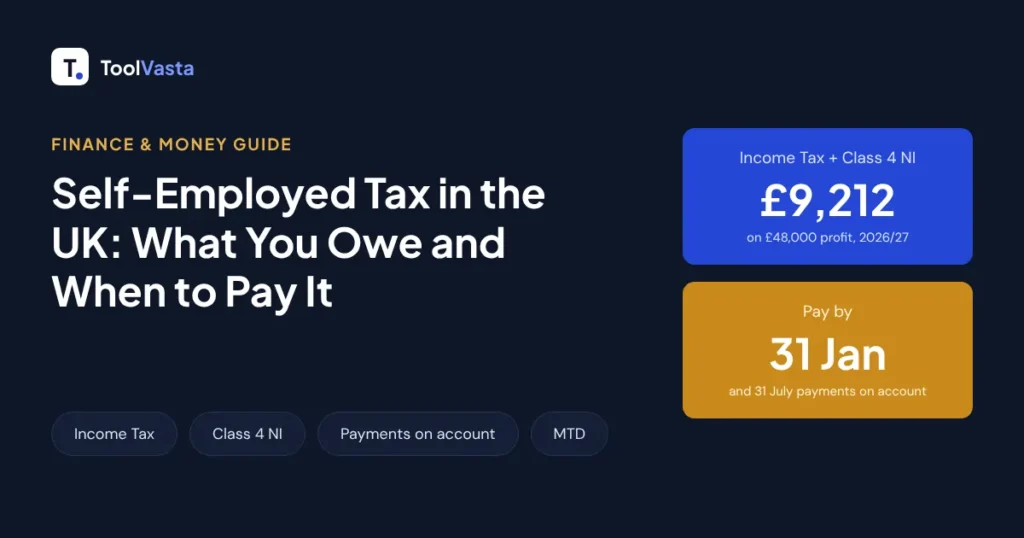
Quick answer: Self-employed people in the UK pay Income Tax at 20%, 40% or 45% on profit above £12,570, plus Class 4 National Insurance at 6% up to £50,270 and 2% above. For 2026/27 the bill is due by 31 January 2028, with payments on account each January and July if you owe more than £1,000.
Going self-employed changes one thing more than any other: nobody takes tax out of your income before it reaches you. A freelancer, sole trader or contractor receives the full invoice amount and settles up with HMRC once a year through Self Assessment, which is great for cash flow until the January bill lands. This guide explains what you owe on your profit, how the bill is worked out, which costs reduce it and the dates that matter. You can test your own numbers in the self-employed tax calculator as you read, using either UK or US rules.
Who Counts as Self-Employed and When Must You Register?
You are self-employed if you run your own business and take the profit or bear the loss, rather than being paid a wage by an employer. That covers sole traders, freelancers, most gig workers and partners in a partnership. Directors of their own limited company are different: they pay tax through the company and PAYE, and are not covered here.
You need to register for Self Assessment once your self-employed income in a tax year goes above £1,000. Below that, the trading allowance means the income is tax free and you usually do not need to report it. The deadline to register is 5 October after the end of the tax year in which you started, so someone who began trading in June 2026 must register by 5 October 2027. HMRC then sends a Unique Taxpayer Reference, which you need to file a return.
What Taxes Do Self-Employed People Pay in the UK?
Self-employed people pay two main taxes on profit: Income Tax and Class 4 National Insurance. Student loan repayments are also collected through the same return if you have a loan. VAT is a separate matter that only applies once your turnover passes the VAT registration threshold of £90,000.
| Tax, 2026/27 | Profit range | Rate |
|---|---|---|
| Personal Allowance | Up to £12,570 | 0% |
| Basic rate Income Tax | £12,571 to £50,270 | 20% |
| Higher rate Income Tax | £50,271 to £125,140 | 40% |
| Additional rate Income Tax | Over £125,140 | 45% |
| Class 4 National Insurance | £12,570 to £50,270 | 6% |
| Class 4 National Insurance | Over £50,270 | 2% |
These bands apply in England, Wales and Northern Ireland. Scottish taxpayers use six Income Tax bands, from a 19% starter rate to a 48% top rate, so the higher rate starts at £43,663 instead of £50,271. National Insurance is the same everywhere in the UK.
Class 2 National Insurance used to be a flat weekly charge on all self-employed people. Since April 2024 nobody has to pay it: if your profit is above the £7,105 Small Profits Threshold you get the National Insurance credit for your State Pension automatically, and below it you can choose to pay £3.65 a week voluntarily to keep your record complete.
Your Personal Allowance shrinks by £1 for every £2 of income above £100,000 and disappears at £125,140. Profit in that band is effectively taxed at 60% plus 2% National Insurance, which is why many high earners pay extra into a pension to bring their adjusted income back under £100,000.
How Do You Work Out Your Self-Employed Tax Bill?
You work out your bill from profit, which is your income minus allowable expenses, not from your turnover. Here is a typical example for a designer in England in 2026/27.
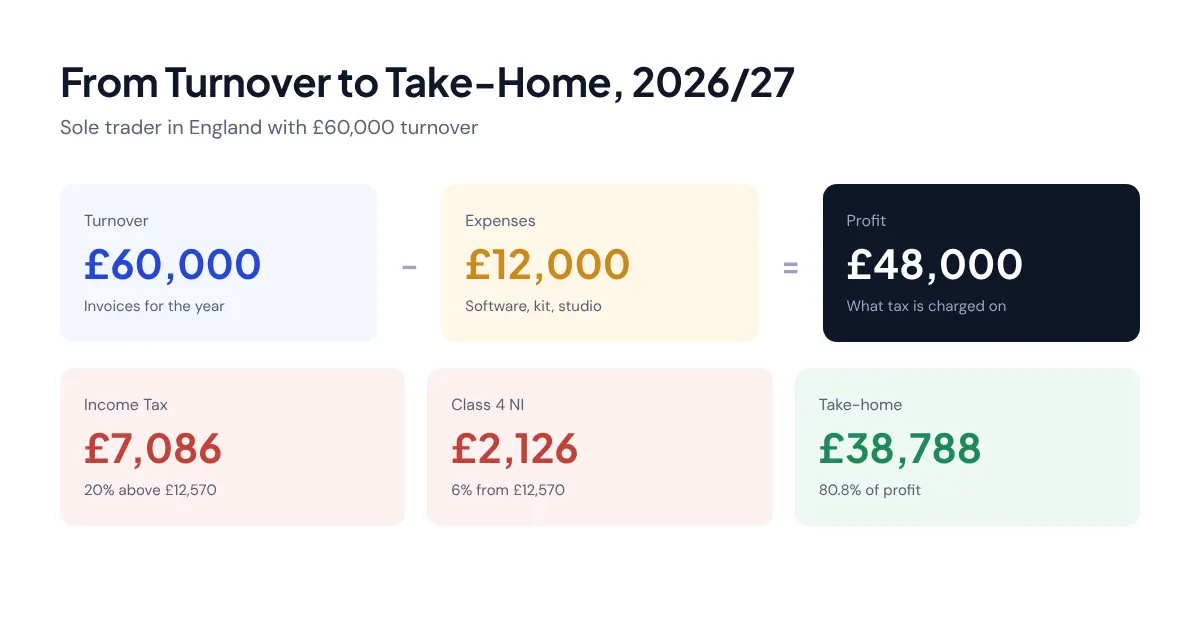
- Turnover of £60,000 minus £12,000 of allowable expenses gives a profit of £48,000.
- Take off the £12,570 Personal Allowance to leave £35,430 of taxable profit.
- Income Tax at 20% on £35,430 is £7,086.
- Class 4 National Insurance at 6% on £48,000 minus £12,570 is £2,125.80.
- The total bill is £9,211.80, about 19% of profit, leaving £38,788.
A simple habit makes this manageable: move a fixed share of every payment you receive into a separate savings account. Basic rate taxpayers usually need 15% to 20% of profit; once part of your profit is taxed at 40%, put aside 25% to 30%. The table below shows how the total grows with profit for someone with no other income and no student loan.
| Profit | Income Tax | Class 4 NI | Total | Share of profit |
|---|---|---|---|---|
| £15,000 | £486 | £146 | £632 | 4.2% |
| £25,000 | £2,486 | £746 | £3,232 | 12.9% |
| £35,000 | £4,486 | £1,346 | £5,832 | 16.7% |
| £50,000 | £7,486 | £2,246 | £9,732 | 19.5% |
| £75,000 | £17,432 | £2,757 | £20,189 | 26.9% |
| £100,000 | £27,432 | £3,257 | £30,689 | 30.7% |
Which Expenses Reduce Your Tax?
Allowable expenses are costs you incur wholly and exclusively to run the business, and each £1 you claim saves you 26p as a basic rate taxpayer (20% tax plus 6% NI). HMRC sets out the categories in its guide to expenses if you are self-employed. The common ones are:
- Stock, materials and goods you resell.
- Office costs such as software, phone and broadband, stationery and postage, for the business share.
- Travel for work, including fuel or train fares, but not your normal commute to a fixed workplace.
- Professional costs such as accountancy fees, insurance and trade body membership.
- Marketing, website hosting and advertising.
- Training that updates skills you already use in the business.
Two simplified methods save record keeping. For a car or van you can claim 45p a mile for the first 10,000 business miles and 25p after that, instead of actual running costs; the mileage reimbursement calculator works out the total. If you work from home for 25 hours or more a month, you can claim a flat £10, £18 or £26 a month depending on hours, instead of splitting your bills.
When Do You Pay Self-Employed Tax?
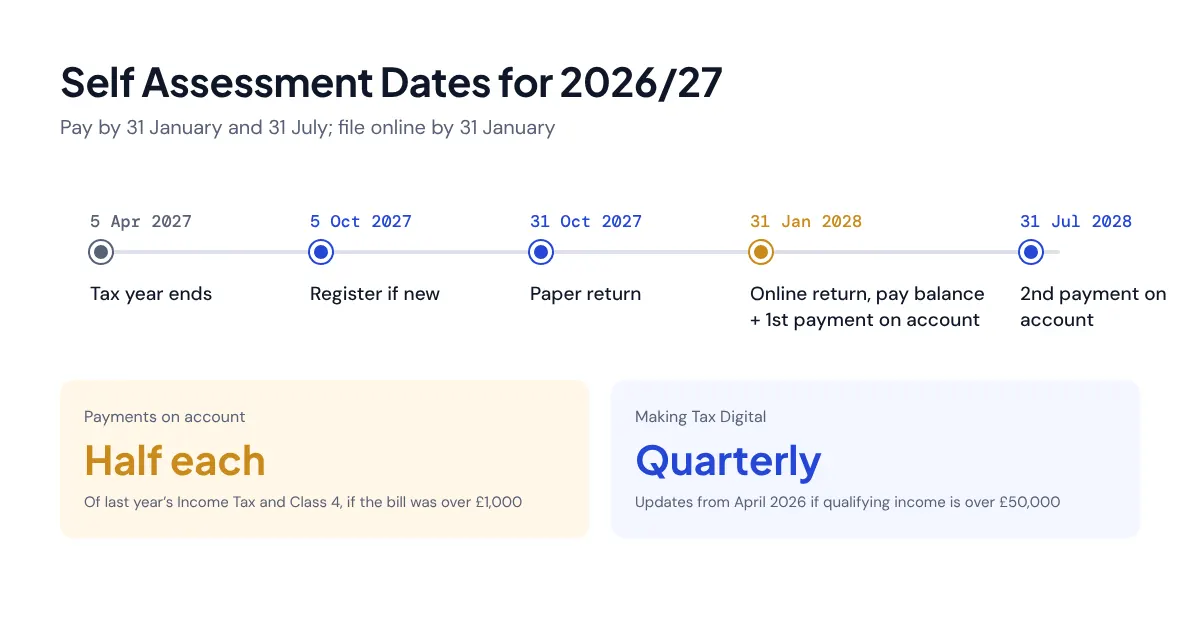
You pay in January and July. The tax year runs from 6 April to 5 April, and the balance for the year is due on 31 January after it ends, which is also the deadline for filing online. The key dates for the 2026/27 tax year are:
| Date | What happens |
|---|---|
| 5 April 2027 | 2026/27 tax year ends |
| 5 October 2027 | Deadline to register if you started trading in 2026/27 |
| 31 October 2027 | Paper tax return deadline |
| 31 January 2028 | Online return deadline, balancing payment for 2026/27 and first payment on account for 2027/28 |
| 31 July 2028 | Second payment on account for 2027/28 |
Payments on account catch many people out in their second year. If your last bill was more than £1,000 and less than 80% of your tax was collected at source, HMRC asks for two advance payments towards next year, each half of this year's Income Tax and Class 4 bill. On the £48,000 example, the January after your first full year means paying £9,212 for the year just gone plus £4,606 towards the next one, a total of £13,818. You can ask HMRC to reduce payments on account if you expect your profit to fall, but you pay interest if the reduction turns out to be too much. The official list of dates is on the GOV.UK page for Self Assessment deadlines.
Making Tax Digital for Income Tax also started on 6 April 2026 for sole traders and landlords with qualifying income over £50,000. They keep digital records and send quarterly updates through compatible software, by 7 August, 7 November, 7 February and 7 May, then finalise the year by 31 January. The threshold falls to £30,000 from April 2027 and £20,000 from April 2028. The tax itself is still paid on the same January and July dates.
What If You Are Employed and Self-Employed at the Same Time?
If you also have a job, your salary uses up your Personal Allowance and some or all of the basic rate band first, so all of your self-employed profit may be taxed at 20% or 40% from the first pound. A nurse who does private clinics or a teacher who tutors at weekends is in this position. Class 1 National Insurance on your wages and Class 4 on your profit are worked out separately, although there is an annual maximum that stops you paying too much overall.
To estimate this, work out your take-home pay from the job first. NHS staff can use the NHS pay calculator to see their 2026/27 salary after tax, National Insurance and pension, then treat their self-employed profit as sitting on top of that income. If you owe less than £3,000 and file online by 30 December, HMRC can usually collect the tax through your tax code instead of a lump sum in January.
How Does the UK Compare With Self-Employed Tax in the US?
The US charges a flat 15.3% self-employment tax for Social Security and Medicare on 92.35% of net profit from the first $400, which is much heavier than Class 4 National Insurance on small profits. Federal income tax then applies on top, after the standard deduction of $16,100 for a single filer in 2026, half of the self-employment tax and a 20% deduction for qualified business income. Tax is paid in four quarterly estimates rather than twice a year.
US employees, by contrast, have a new break for 2025 to 2028: the premium part of overtime pay can be deducted from federal taxable income, up to $12,500. The no tax on overtime calculator shows how much that saves, which is a useful comparison for anyone weighing a contract role against an hourly job across the Atlantic.
What Happens If You Pay or File Late?
Missing the 31 January filing deadline triggers an immediate £100 penalty, even if you owe nothing. After three months, £10 a day is added for up to 90 days, and further penalties of 5% of the tax due, or £300 if higher, follow at six and twelve months. Paying late adds interest from the day after the deadline, plus a 5% penalty on tax still unpaid after 30 days, six months and twelve months.
If you cannot pay in full, you can usually set up a Time to Pay arrangement online for bills up to £30,000 once your return is filed. Interest still runs, but an arrangement agreed before a penalty date stops that penalty being charged.
Frequently asked questions
How much tax do I pay on £30,000 self-employed profit?
In England, Wales or Northern Ireland for 2026/27, you pay £3,486 Income Tax and £1,045.80 Class 4 National Insurance, a total of £4,531.80. That leaves £25,468, and you should set aside about £378 a month.
Do I pay tax on my first £1,000 of self-employed income?
No. The trading allowance makes the first £1,000 of gross trading income tax free. If you earn more, you can deduct the £1,000 allowance instead of your actual expenses when that gives a bigger deduction.
When is my first Self Assessment payment due?
By 31 January after the end of the tax year in which you started. If you started in 2026/27, the first payment is due by 31 January 2028, often together with your first payment on account for 2027/28.
Can I reduce my payments on account?
Yes. If you expect lower profit next year, you can apply to reduce them online or with form SA303. If the final bill is higher, you pay the difference plus interest.
Do I need to register for VAT as a sole trader?
Only if your taxable turnover goes over £90,000 in any rolling 12 months, or you expect it to within the next 30 days. You can register voluntarily below that if it suits your business.