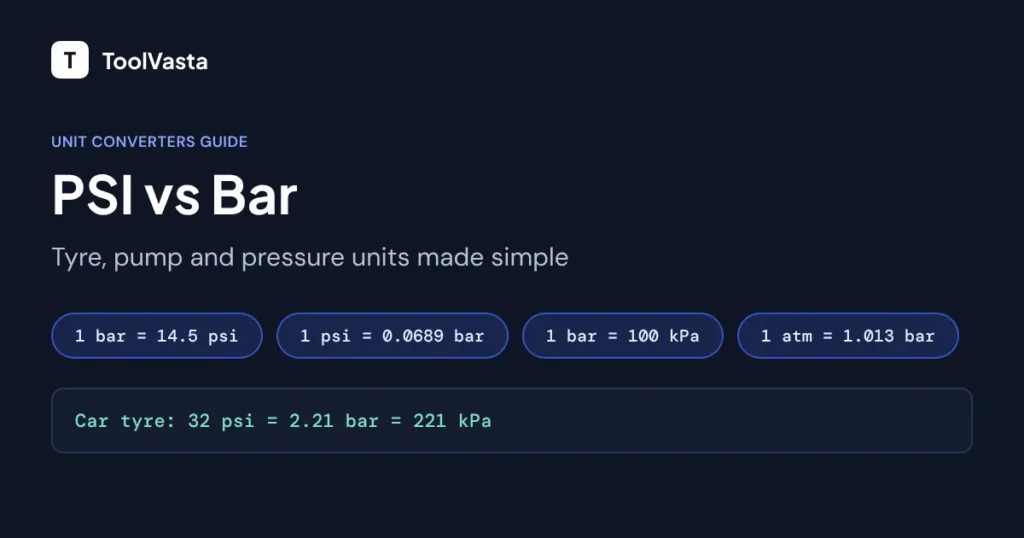
Quick answer: PSI and bar both measure pressure. One bar is 14.5 psi, and one psi is 0.0689 bar. To turn psi into bar, divide by 14.5; to turn bar into psi, multiply by 14.5. A typical car tyre at 32 psi is therefore about 2.2 bar, or 221 kPa.
Pull into a petrol station forecourt in the UK and the air machine may ask for psi, bar or both. Your car handbook, printed in Germany or Japan, might list 2.3 bar, while the sticker on a bike tyre says 80 to 100 psi, and the espresso machine on your kitchen worktop boasts 15 bar. They are all describing the same physical quantity, force spread over an area, in different units. Once you know that one bar is about 14.5 psi, every one of those numbers falls into place, and the bar to psi converter will do the exact sum in either direction when you need more than a rough figure.
This guide explains where each unit comes from, how to convert between them in your head, what gauge pressure means and how to get tyre pressures right. Along the way it touches on speed units for driving abroad with the mph to km/h converter, and kitchen measures with the tablespoon to ml converter for pressure cooker recipes.
What Is PSI?
PSI stands for pounds per square inch, or more precisely pound-force per square inch. It is the pressure created when a force of one pound pushes on an area of one square inch. It belongs to the imperial and US customary systems, so it is the everyday pressure unit in the United States and is still printed on most tyres, pumps and gauges sold in the UK.
In SI terms, one psi is 6,894.757 pascals, or about 6.9 kilopascals. That is a small pressure compared with the air around us: the atmosphere at sea level presses on everything with about 14.7 psi.
What Is a Bar?
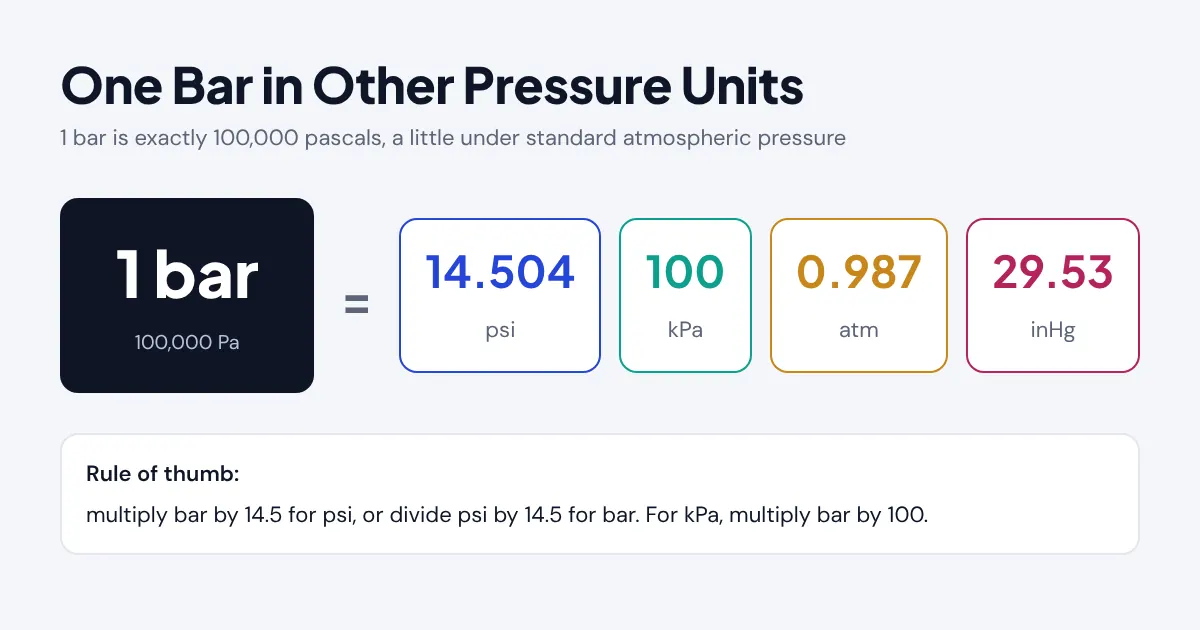
The bar is a metric unit defined as exactly 100,000 pascals (100 kPa). It was chosen because it is very close to normal atmospheric pressure, which makes it easy to picture: 1 bar is roughly the weight of the air above you at sea level. Standard atmospheric pressure is 1.01325 bar, so the two are within about 1.3% of each other.
The bar is not an SI unit, but it is widely used across Europe for tyres, hydraulics, diving cylinders, weather (as millibars) and coffee machines. Tyre information in Canada and Australia is often given in kilopascals instead, which is simply bar multiplied by 100.
How Do You Convert PSI to Bar and Bar to PSI?
Divide psi by 14.5038 to get bar, and multiply bar by 14.5038 to get psi. The factor comes straight from the definitions: 100,000 pascals in a bar divided by 6,894.757 pascals in a psi. The US National Institute of Standards and Technology lists the psi to pascal factor in Appendix B of its Guide to the SI, which is the reference most engineering calculators use.
psi = bar × 14.5038
kPa = psi × 6.894757 = bar × 100
For mental arithmetic, 14.5 is close enough for any tyre or pump. A quick way to divide by 14.5 is to divide by 15 and add a little: 30 psi ÷ 15 = 2.0, and the real answer is 2.07 bar. Going the other way, multiply bar by 15 and take off a little: 2.4 bar × 15 = 36, and the exact answer is 34.8 psi. Remember that the shortcut always overshoots when multiplying, so knock off about one psi for every 2 bar.
Here is a reference table for the pressures you are most likely to meet:
| PSI | Bar | kPa |
|---|---|---|
| 10 psi | 0.69 bar | 69 kPa |
| 15 psi | 1.03 bar | 103 kPa |
| 20 psi | 1.38 bar | 138 kPa |
| 25 psi | 1.72 bar | 172 kPa |
| 28 psi | 1.93 bar | 193 kPa |
| 30 psi | 2.07 bar | 207 kPa |
| 32 psi | 2.21 bar | 221 kPa |
| 33 psi | 2.28 bar | 228 kPa |
| 35 psi | 2.41 bar | 241 kPa |
| 36 psi | 2.48 bar | 248 kPa |
| 38 psi | 2.62 bar | 262 kPa |
| 40 psi | 2.76 bar | 276 kPa |
| 45 psi | 3.10 bar | 310 kPa |
| 50 psi | 3.45 bar | 345 kPa |
| 60 psi | 4.14 bar | 414 kPa |
| 80 psi | 5.52 bar | 552 kPa |
| 100 psi | 6.89 bar | 689 kPa |
| 120 psi | 8.27 bar | 827 kPa |
What Is the Difference Between Gauge and Absolute Pressure?
Gauge pressure is measured relative to the surrounding air, while absolute pressure is measured from a perfect vacuum. A flat tyre still contains air at about 1 bar absolute, the same as the atmosphere, but a tyre gauge reads zero because there is no difference between inside and outside. Every tyre pressure, pump reading and pressure cooker figure in everyday life is a gauge reading.
Engineers mark the difference with a letter. In US units, psig means gauge and psia means absolute; in metric, barg and bara do the same job. To convert, add or subtract atmospheric pressure: 32 psig is about 46.7 psia, and 2.2 barg is about 3.2 bara. If a technical sheet does not say which it means, assume gauge for anything you inflate and absolute for weather, altitude and vacuum work, where the pressure altitude calculator uses absolute readings.
What Tyre Pressure Should Your Car Have?
Use the pressure your vehicle manufacturer gives, not the maximum number moulded into the tyre sidewall. The sidewall figure is the most the tyre can safely hold, not what your car needs. The recommended pressures are printed on a placard inside the driver's door frame, inside the fuel filler flap or in the handbook, often with separate front and rear figures and a higher setting for a fully loaded car.
In the UK this is a legal requirement as well as good sense. The Highway Code vehicle maintenance annex says tyres must be inflated to the manufacturer's specification for the load being carried, and advises checking pressures weekly, before a journey, while the tyres are cold. Driving even a few miles warms the air inside and raises the reading, so a hot tyre that looks correct may be underinflated once it cools.
Temperature matters in winter too. Tyre pressure falls by roughly 1 psi (about 0.07 bar) for every 5 to 6 °C drop in air temperature, so tyres set on a mild autumn afternoon can be 2 or 3 psi low on a frosty morning. Underinflated tyres wear faster at the edges, use more fuel and take longer to stop.
Speed is the other factor. Many handbooks list a higher pressure for sustained high speed, and every tyre carries a speed rating letter defined in km/h: H means 210 km/h, V means 240 km/h and W means 270 km/h. If you are towing a caravan across France, where limits are signed in km/h, it helps to know that 130 km/h is about 81 mph. The mph to km/h converter linked above turns any limit or rating into the unit on your speedometer, and the tyre size calculator shows how a change of tyre size affects speedometer accuracy.
Which Pressure Units Do Pumps and Gauges Use?
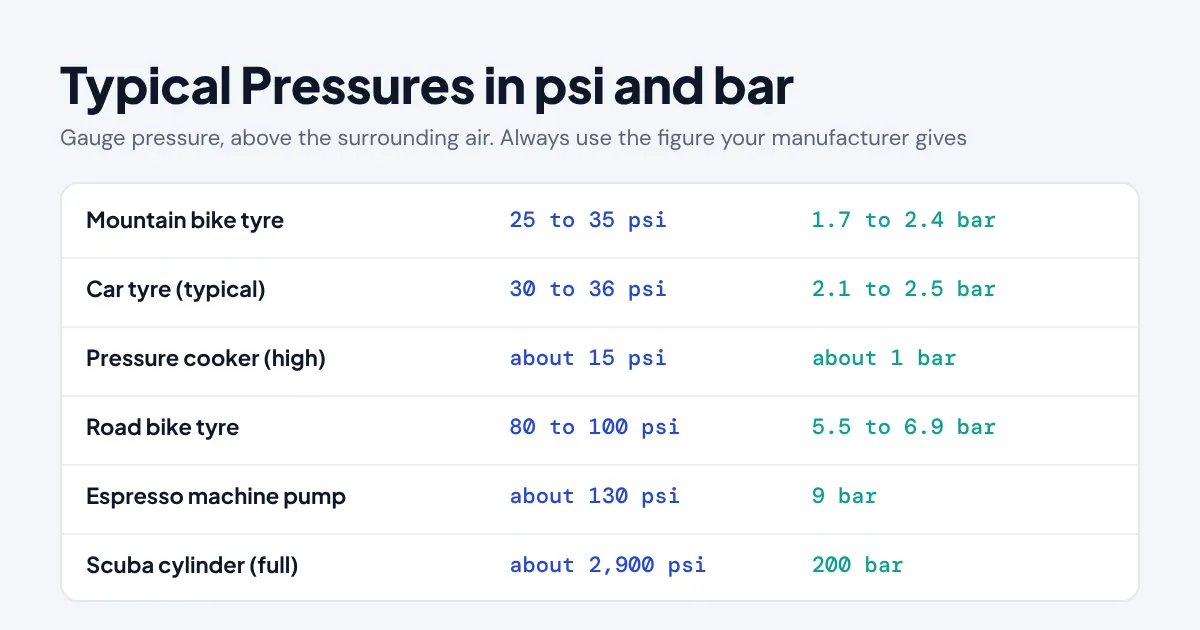
Most digital pumps and forecourt air machines let you switch between psi, bar and kPa, and many dial gauges print psi on the outer ring and bar on the inner one. Bicycle track pumps usually show both, because road tyres are often quoted in psi (80 to 100) and mountain bike tyres in bar (about 1.7 to 2.4). Check which scale you are reading before you inflate: mistaking 2.4 psi for 2.4 bar would leave a car tyre almost flat, and the reverse would burst a bike inner tube.
In the kitchen, the units mix in the same way. Espresso machines advertise 9 to 15 bar at the pump, while stovetop pressure cookers usually run at about 15 psi, which is 1 bar above atmospheric pressure. Pressure cooker recipes also specify a minimum amount of liquid to make steam, often in cups or tablespoons in American books and in millilitres in British ones, so a spoon conversion and a pressure conversion can both turn up in the same recipe.
What Are the Most Common PSI and Bar Mistakes?
The first is setting tyres to the sidewall maximum, which overinflates them, reduces grip and gives a harsh ride. The second is checking pressures straight after a drive, when warm air gives a reading 2 to 4 psi higher than the true cold figure. The third is confusing kPa with psi on a pump set to metric: 220 kPa is a sensible car tyre pressure, but 220 psi would be dangerous. Finally, rounding 14.5038 to 14 instead of 14.5 adds an error of over 3%, which on a 36 psi tyre is a full psi out.
When in doubt, convert the manufacturer's figure exactly, set the pump to that unit and leave it there for the whole job.
Frequently asked questions
Is 2.2 bar the same as 32 psi?
Very nearly. 2.2 bar is 31.9 psi, and 32 psi is 2.21 bar. For tyre pressures the two can be treated as the same setting.
How many psi is 1 bar?
One bar is 14.5038 psi, usually rounded to 14.5 psi.
Is higher bar or psi better for tyres?
Neither. The right pressure is the one in your vehicle handbook or door placard. Higher than recommended reduces grip and comfort, lower increases wear, fuel use and stopping distances.
Why do some tyres list kPa?
Kilopascals are the SI unit used in Canada, Australia and on many tyre placards. 1 bar is 100 kPa, so 230 kPa is 2.3 bar or about 33 psi.
Does a tyre gauge show gauge or absolute pressure?
Gauge pressure. It reads the difference between the air inside the tyre and the air outside, so a fully deflated tyre reads zero.