Lorem ipsum is the scrambled Latin that fills web pages, posters and app screens before the real words arrive. It looks like language, it has the rhythm of language, and yet nobody is meant to read it. If you just need some now, the lorem ipsum generator makes paragraphs, sentences, words or an exact number of characters in one click. This guide covers where the text really comes from, why designers still use it, and how to avoid the mistakes that let it slip onto live pages.
It also covers two close cousins of placeholder text that cause trouble in modern design work: invisible characters that hide inside copied text, and the styled Unicode letters people paste into social bios.
Where Does Lorem Ipsum Come From?
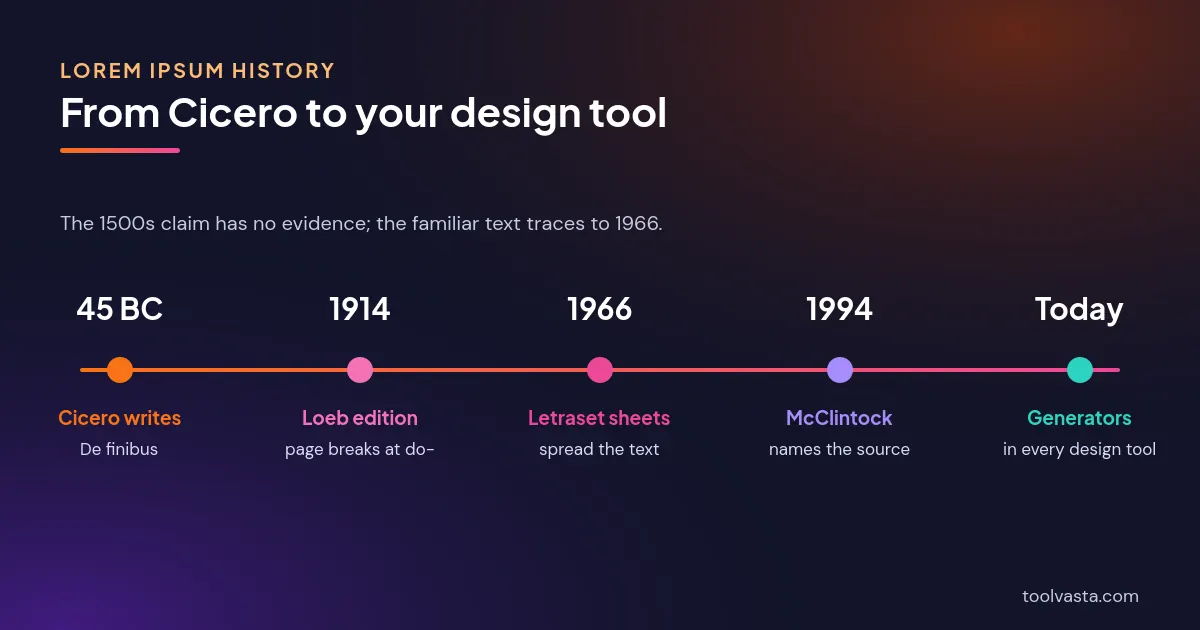
Lorem ipsum comes from a real book: De finibus bonorum et malorum ("On the Ends of Good and Evil"), a work of moral philosophy that the Roman statesman Cicero wrote in 45 BC. The placeholder is a corrupted version of sections 1.10.32 and 1.10.33, a passage about whether anyone seeks out pain for its own sake.
The original Latin reads, in part, "Neque porro quisquam est, qui dolorem ipsum quia dolor sit amet...", meaning "Nor is there anyone who loves pain itself because it is pain". You can read the full passage in the Perseus Digital Library at Tufts University. Notice the phrase "dolorem ipsum". Cut off the first syllable and you get "lorem ipsum", the two words that now name the whole genre.
Who Worked Out the Source?
For decades, designers used the text without knowing where it came from. The first published explanation is credited to Richard McClintock, a Latin scholar at Hampden-Sydney College in Virginia. He noticed the unusual word "consectetur", searched classical literature for it, and traced it to Cicero. He explained the connection in a 1994 letter to the editor of Before & After magazine.
That same letter is the origin of the popular claim that printers have used lorem ipsum "since the 1500s". McClintock has since said the date was a guess with no evidence behind it, so treat any website that repeats it with caution.
How Did It Become the Standard Placeholder?
The evidence points to the 1960s rather than the Renaissance. Letraset, the British company that sold dry-transfer lettering sheets to designers, printed the familiar version of the text on sheets first published in 1966. Designers rubbed those letters onto layouts to show how body copy would look, and the passage spread with the sheets.
There is also a neat theory about why the text starts mid-word. In the 1914 Loeb Classical Library edition of De finibus, the Latin breaks at the bottom of one page with "qui do-" and continues on the next with "lorem ipsum". Someone copying from the top of a page would have started with "lorem". It is a plausible explanation, not a proven one. Desktop publishing and word processors later made the text a default, and today it ships with design tools, website themes and code libraries.
Does Lorem Ipsum Mean Anything?
Lorem ipsum means nothing as a whole. Many of the words are genuine Latin, such as dolor (pain), magna (great) and labore (work), but they are shuffled, cut and sometimes invented, so the sentences do not translate.
That meaninglessness is the point. Placeholder text should look like text without inviting anyone to read it. If you fill a mockup with real English, reviewers start editing the sentences instead of judging the layout, the spacing and the type. Latin-like text keeps attention on the design, and its mix of short and long words gives a realistic texture of ascenders, descenders and word lengths.
The classic opening: "Lorem ipsum dolor sit amet, consectetur adipiscing elit, sed do eiusmod tempor incididunt ut labore et dolore magna aliqua." When people say lorem ipsum, they usually mean text that starts with this sentence.
How Much Placeholder Text Should You Use?
Match the placeholder to the length of the real copy you expect. Too little hides layout problems, and too much makes a section look busier than it will be. A quick rule is to multiply paragraphs by sentences by words.
With typical lorem ipsum, a paragraph has 4 to 7 sentences of 6 to 14 words, so it averages about 55 words. Three paragraphs give roughly 165 words, enough for an About section or a blog intro. For anything with a hard limit, such as a meta description, a product card or a form field, generate an exact character count instead.
| Element | Realistic length | Generate |
|---|---|---|
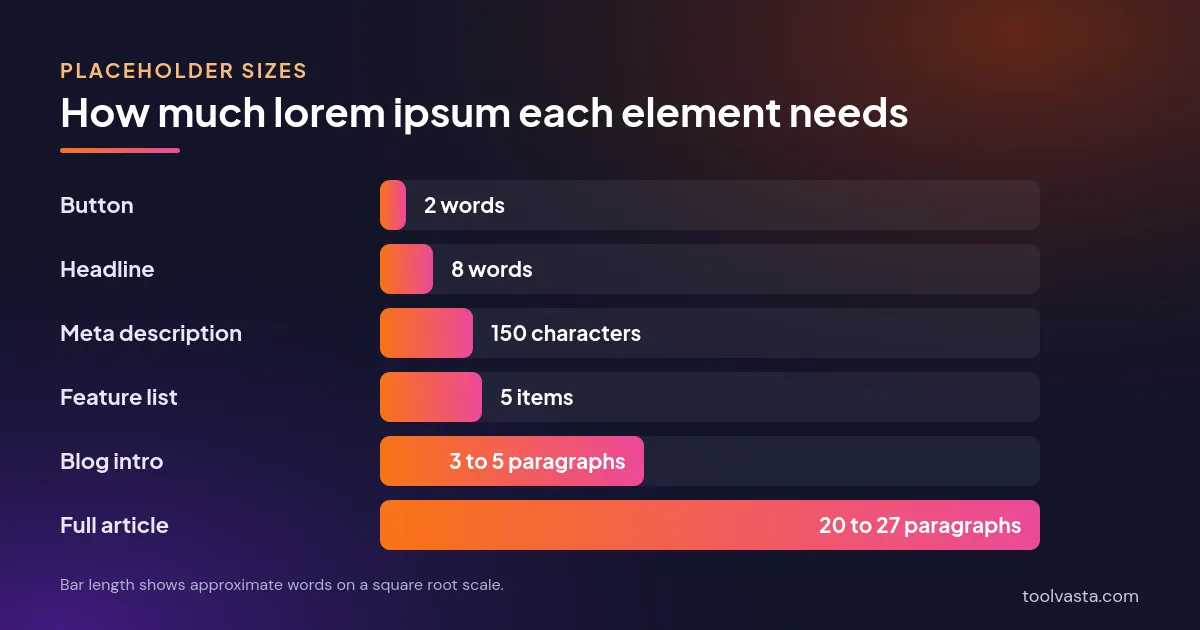
| Button or menu item | 1 to 3 words | 2 words |
| Headline | 6 to 12 words | 8 words |
| Meta description | Up to about 155 characters | 150 characters |
| Feature list | 3 to 6 short items | 5 list items |
| Blog intro or About section | 150 to 300 words | 3 to 5 paragraphs |
| Full article template | 1,000 to 1,500 words | 20 to 27 paragraphs |
How Do You Use Lorem Ipsum Well?
Use lorem ipsum when the structure is ready and the words are not, and keep it out of anything a customer will see. These habits keep it useful.
- Size it to the real content. Ask the writer for an expected length, then generate that much.
- Test the extremes. Try a very short and a very long version of each block to see where text wraps, overflows or leaves gaps.
- Use HTML output in code. Paragraphs wrapped in <p> tags and lists in <ul> tags paste straight into templates.
- Mark it clearly. Keep the "Lorem ipsum dolor sit amet" opening so nobody mistakes it for approved copy.
- Search before launch. Run a site search for "lorem" and "ipsum" on staging and again after you go live.
Common Mistakes to Avoid
- Publishing it: lorem ipsum on a live page looks unfinished, adds nothing for readers, and gives search engines thin content to index.
- Designing around it forever: real copy is rarely as neat. Headlines run long, names have accents, and translations can be much longer than the English. Swap in real text as early as you can.
- Forgetting accessibility: a screen reader will read the Latin aloud. Placeholder text in a demo is fine, but never leave it in alt text, labels or buttons.
- Confusing it with form placeholders: the grey hint inside an input is a different thing. The W3C Web Accessibility Initiative forms tutorial explains why those hints should not replace real labels.
What About Invisible Placeholder Characters?
Sometimes the problem is not text you can see but text you cannot. Copying from PDFs, chat apps and some websites can bring along zero width spaces, no-break spaces and other invisible characters. They break searches, stop passwords from matching and make two identical-looking lines count as different.
Designers also use blank characters on purpose, for example to keep an empty line in a profile or to test how a form handles a name that looks empty. The invisible character tool does both jobs: it copies blank characters such as the Hangul Filler (U+3164), and it scans pasted text to list and remove hidden ones, including Unicode tag characters that can carry a secret message.
Placeholder Text for Social Media Mockups
When you mock up an Instagram profile or a post for a client, lorem ipsum is handy for captions, but bios are short enough to write for real. A bio allows 150 characters, so generate exactly 150 characters to see how a full bio wraps on a phone screen, then replace it with the client's words.
Many brands style the first line of a bio with Unicode letters. The Instagram font generator shows how long each style is against the 150 character limit and keeps hashtags and @mentions in plain letters so they still link. Use styled text for one line at most, since screen readers can struggle with it, and check longer captions with the character counter before you post.
Frequently asked questions
Why is it called lorem ipsum?
The name comes from the first two words of the placeholder, which are a clipped form of "dolorem ipsum", Latin for "pain itself", from Cicero's De finibus.
Has lorem ipsum really been used since the 1500s?
There is no evidence for that. The claim came from a 1994 letter whose author later said the date was a guess. The familiar version can be traced to Letraset transfer sheets from 1966.
Is it okay to publish lorem ipsum?
No. It is meant for drafts and mockups. On a live page it confuses visitors, reads aloud as Latin to screen reader users and gives search engines nothing useful.
What can I use instead of lorem ipsum?
Draft copy written for the real audience is best. When that is not ready, realistic sample content in the right language helps you test word lengths and line breaks more honestly than Latin.