A good character name does three jobs at once: it fits the world, it hints at who the character is, and it is easy for readers or players to remember. Most naming problems come from missing one of those jobs, not from a lack of ideas. This guide gives you nine practical rules, plus quick ways to generate options with the DnD name generator, the dragon name generator and the random letter generator when you need a starting point fast.
The rules work the same way for a novel, a screenplay, a video game or a Dungeons & Dragons campaign. The difference is speed: a novelist can spend a week on a name, while a game master may need one in five seconds when the players ask the innkeeper who she is.
Why Does a Character's Name Matter?
A character's name matters because it is the first piece of characterization the audience gets, often before a single line of dialogue. Readers form an impression of age, background and temperament from a name alone, and that impression either supports the story or quietly fights it.
Names also do practical work. In a long book or campaign, the audience has to track dozens of people. If three of them are called Mara, Maya and Mira, readers will mix them up no matter how well they are written. A strong name is distinct on the page, easy to say aloud and hard to confuse with anyone else in the cast.
How Do You Name a Character? 9 Rules That Work
To name a character, start from the world they live in, choose sounds that match their personality, and then test the name against the rest of the cast. The nine rules below follow that order.
1. Start with the world, not the name
Decide where and when the character was born before you pick anything. A woman born in Ohio in 1950 is more likely to be a Linda or a Carol than a Harper. For real-world settings, the Social Security Administration's baby name data lists the most popular US names for every year since 1880, which makes it easy to check what parents were actually choosing. For family names, the US Census Bureau's surname tables show which surnames are common and how they vary across groups.
Fantasy worlds need the same thinking. If a mountain kingdom speaks a language inspired by Old Norse, its people should share sounds and endings, so a name from that kingdom feels like it belongs there.
2. Let the sound hint at the personality
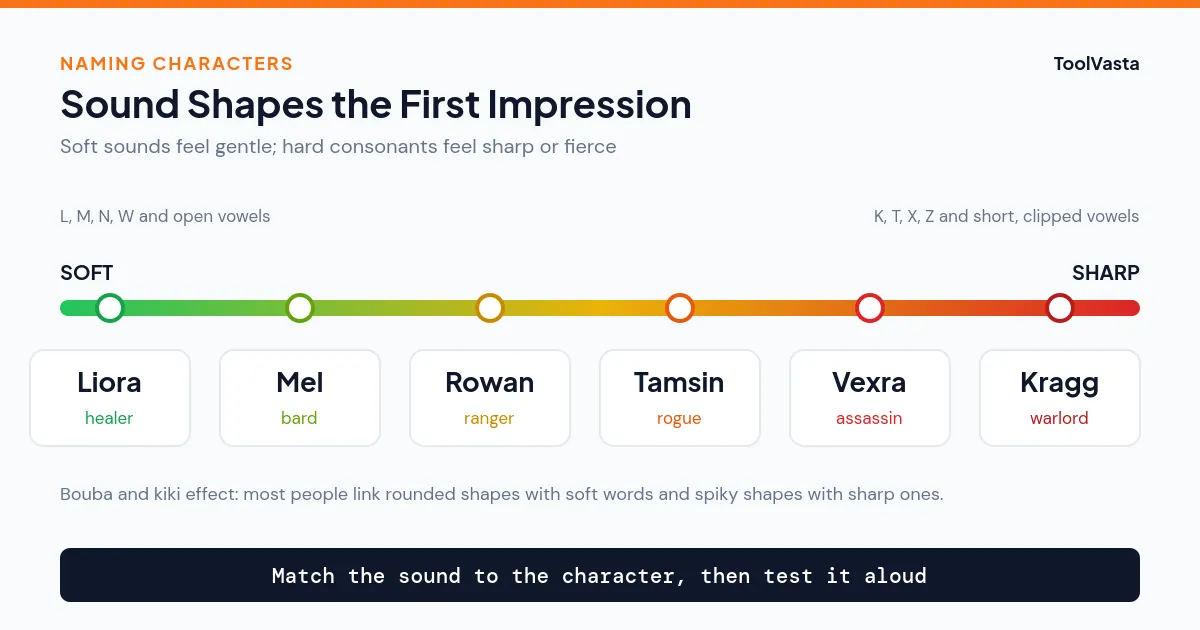
Sounds carry meaning before the reader knows any facts. In a classic experiment first run by psychologist Wolfgang Köhler in 1929, people matched a rounded shape with a soft made-up word and a spiky shape with a sharp one, and later studies using the words "bouba" and "kiki" found the same pattern in most people. Writers can use this: hard consonants such as K, T, X and Z feel sharp or aggressive, while L, M, N and open vowels feel gentle.
3. Vary first letters and lengths across the cast
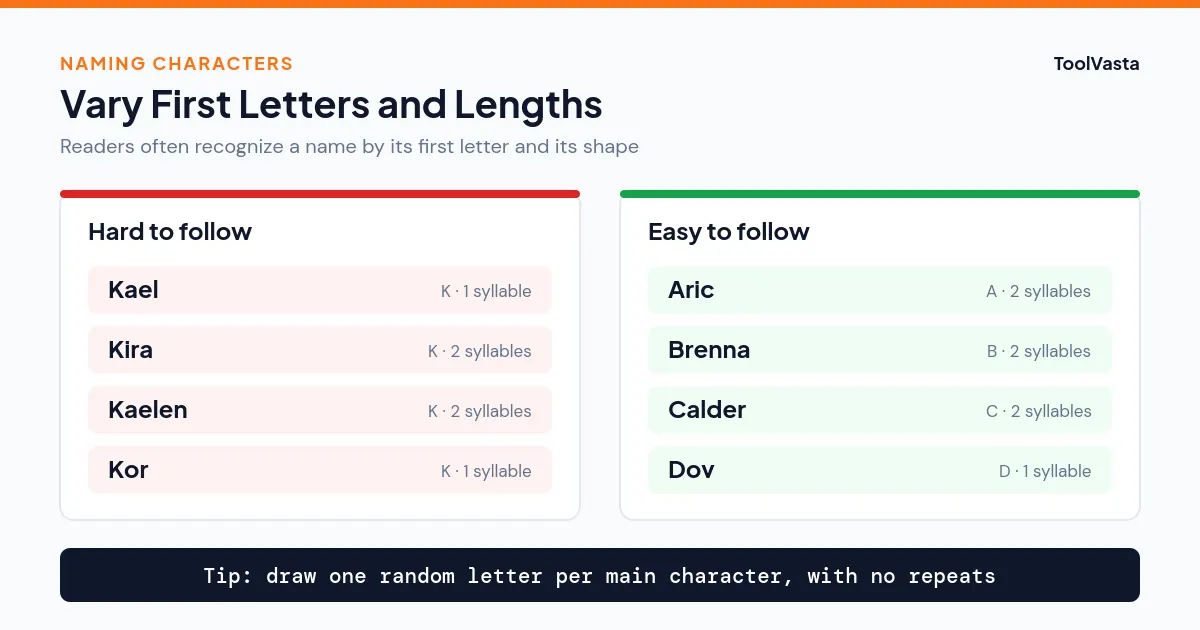
The fastest fix for a confusing cast is to give main characters different first letters and different syllable counts. Readers skim, and the first letter plus the overall shape of a word is often all they register. A party of Aric, Brenna, Calder and Dov is far easier to follow than Kael, Kira, Kaelen and Kor.
If you tend to repeat favorite letters, draw them at random instead. Set the random letter generator to the party game set with No repeats ticked, draw one letter per main character, and you get a cast with built-in variety. Then type each letter into the Starts with box of the DnD name generator to get names that match.
4. Make sure the name can be said aloud
Say the name out loud three times, then imagine a friend reading it with no help. If they would hesitate, readers will too, and players at a table will invent their own version. Apostrophes and doubled vowels look exotic but slow people down. One unusual feature per name is plenty.
5. Check the meaning, but do not lean on it
A name's meaning is a pleasant bonus for readers who look it up, but very few will. Check that a real name does not mean something embarrassing in the language it comes from, then choose it for how it sounds and what it suggests. A hidden meaning is best treated as an Easter egg, not the reason the name works.
6. Follow the naming habits of each culture or species
In fantasy games, each people should name its children in a recognizable way. In Dungeons & Dragons, dwarves carry clan names, goliaths earn a nickname, and many tieflings choose a single virtue word such as Hope or Torment. The DnD name generator follows those habits for 11 species, so a dragonborn paladin and a halfling rogue in the same party will never sound like siblings. Tick the class and hook option and each name comes with a one-line backstory seed as well.
7. Give monsters and dragons a name with weight
Big threats deserve names that sound old and earned. Two or three syllables, a hard ending and a title work well: compare "the red dragon" with "Vorthrax the Ash-Crowned Tyrant". The dragon name generator builds names from roots that each carry a meaning, so you can tell players that Vorthrax means "flame destroyer" when they finally learn the beast's true name. For a gentler creature, its pet style gives friendly names like Pebble or Mochi.
8. Search the name before you commit
Type the full name into a search engine before you publish or print anything. You are checking for two problems: a famous character with the same name, which will pull readers out of your story, and a real person with an identical name, which can cause trouble if your character behaves badly. A small change to the spelling or surname usually solves both.
9. Keep a name bank
Collect names you like before you need them. Writers keep a notebook; game masters keep a short list of ready names for shopkeepers, guards and rivals, so no one at the table notices the improvisation. In the ToolVasta generators, tap the star next to any name and it stays in your Favorites in that browser, ready to copy on game night.
How Do You Name Characters for Tabletop Games?
For tabletop games, name player characters together at session zero and prepare a list of spare names for everyone else. Player characters are spoken aloud hundreds of times, so short names of two or three syllables work best, and a nickname helps when the full name is long.
- Session zero: agree on the tone. A grim campaign and a comic one need very different names, and one "Sir Fluffington" can change the mood of a serious table.
- Before each session: generate 10 to 20 names across a few species and save them as favorites. When the party asks an unplanned question, read the next name on the list.
- Recurring characters: once a quick name sticks, write it down with one detail, such as "Bargret Ironbeard, smith, missing two fingers". Players remember names that come with a hook.
A Quick Character Name Checklist
Run every important name through these five tests before it goes into the story or onto the character sheet.
| Test | Question to ask | Quick fix |
|---|---|---|
| World fit | Would someone from this place and time have this name? | Check era data or the culture's naming habit |
| Sound | Does the sound match the personality? | Swap soft and hard consonants |
| Cast | Does it share a first letter or length with a main character? | Draw a new first letter at random |
| Speech | Can a stranger say it on the first try? | Remove one apostrophe or doubled vowel |
| Search | Is it already a famous character or real person? | Change the spelling or surname |
When a name passes all five, it is ready. When nothing comes to mind at all, generate a batch, pick the three that feel closest, and adjust a letter or two until one of them fits your character exactly.
Frequently asked questions
How do authors come up with character names?
Most authors start from the character's birthplace, birth year and family, then look up names that fit, such as popular baby names for that year. They test the name aloud, check it against the rest of the cast, and change it if it clashes.
Is it okay to use a name generator for a book?
Yes. Generated names are a starting point, like a list in a baby name book. Many writers generate a batch, pick the closest fit and adjust the spelling so the final name feels personal.
How long should a character's name be?
Main characters usually work best with two or three syllables, because the name is read or said many times. Longer names suit formal or ancient characters, especially if they have a short nickname for everyday use.
Should characters in a story have different first letters?
Yes, for the main cast. Readers often recognize names by their first letter and length, so giving key characters different first letters is the simplest way to avoid confusion.